In this thread, I will be journaling about creative writing.
Previously:
In this thread, I will be journaling about creative writing.
Previously:
I’ve been thinking about my ADHD, and how my interests switch from one project to the next.
I notice that it’s important not to let yourself get “bored” while writing. Boredom, as Joseph Nicolosi points out, is when you don’t give yourself permission to express yourself.
Because when you’re bored, that’s when you start “acting out” ie distracting yourself.
I do not know if boredom is that. I think that the language around “expressing oneself” is actually nonsensical liberal-modern mumbo-jumbo.
I believe that Hans-Georg Moeller is actually correct that the “self” does not even exist. As such, there is no “self” to express.
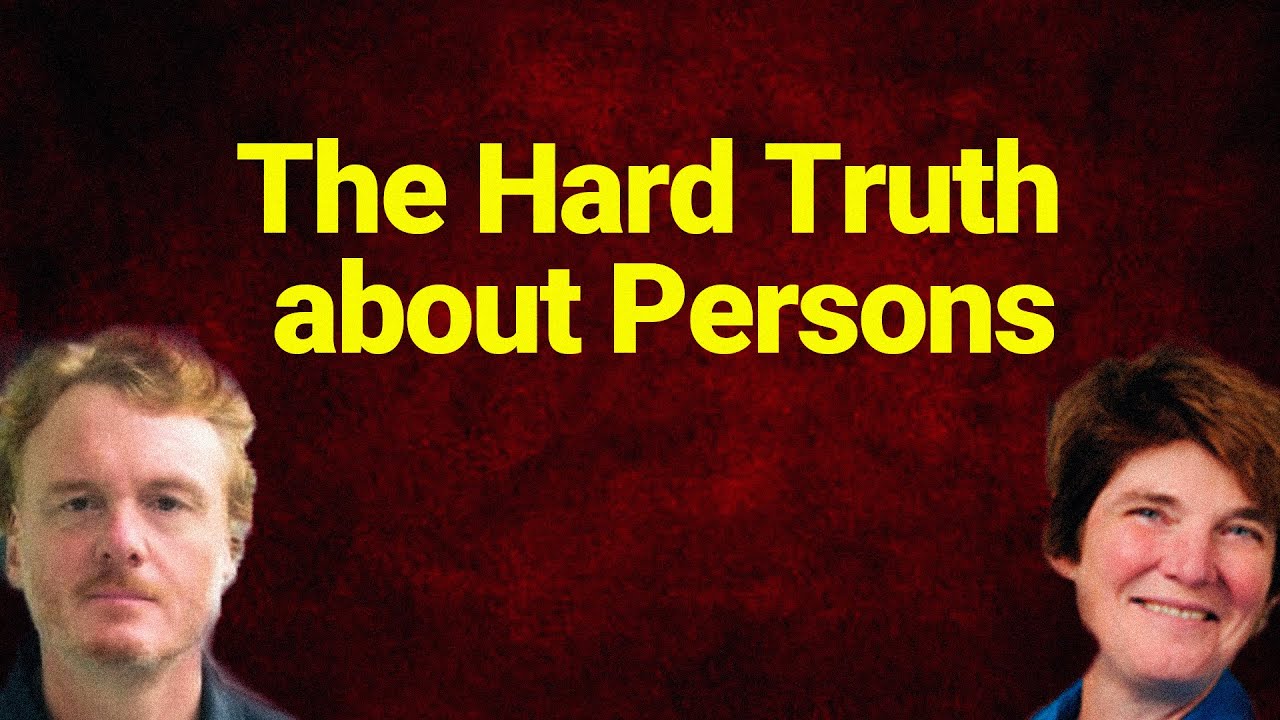
The third video actually blew my mind. Our European ancestors actually did not even have a concept of a “person” in the way that we conceive of persons, today. The word in the English world for person was “wight,” which is derived from a old German word for the same, which itself sounds to a German speaker like a word meaning “something that has weight.”
But, in general, this word “wight” basically meant “a living thing.” So, our ancestors did not view humans as being too different from animals. Certainly not as having some kind of incredibly ineffable and unique “personhood” that must be expressed, as if it brings something monumental into the world.
I think that boredom generally comes from not seeing anything around you as being worth doing. It happens when everything looks like a “stupid waste of time.”
If one gets distracted while doing work, there are two reasons.
Why is this the way the brain works? Am I making junk up?
Here is why. The brain is a predictive machine. Like many statistical algorithms, it has its own system of understanding what future states are reached after certain present states obtain, and it knows when it can bet on an outcome, and when it can’t bet on an outcome.
This prediction is unconscious and rapid. It is not rational, although we can change our predictions with great effort and really damned good reasoning. If it was a completely rational thing, animals would struggle to greatly with it. But animals need to do prediction to survive. A predator needs to predict the trajectory of it’s moving prey. A prey needs to predict the same, and it needs to predict when a predator is likely to be around. Elephants need to guess where water is likely to be. They all need to predict weather. And so on, and so forth. Animals learn, and they learn a lot, and all of this learning is basically related to the brain’s constant activity of prediction.
This predictive ability has a hook to our emotions and urges. Our brain predicts something positive or negative, and then is calls another function in the brain that activates dopamine to make us do the thing, or it activates the amygdala to make us stop the thing from occurring. This is how it makes us act. It would be useless if the brain makes and unconscious prediction and then we don’t even feel it, or feel any urge to do anything in general.
As such, we really need our brain’s predictive functionality to working for us, rather than against us. This predictive function is hacking our emotions and urges and taking over our ability to do stuff. It can’t be turned off - it is too vital a functionality for all animals’ survival for it to be optional.
I just realized, that, for the first time in my life, with this comment, I’ve finally articulated why I do not believe that ADHD is really a thing. I mean…it might be a little bit of a thing, but it’s not the main problem.
So here’s my new writing technique for ADHD. I call it the Twister Method.
Since someone with ADHD is like a tornado, trying to box them in does as much good as trying to box in a tornado. Tornadoes rip through homes, they wander aimlessly, nothing can stop them.
So you can only organize the debris that’s left over afterwards.
So what you do is you work on multiple projects at once within the same document. You write bullet points, switching from one topic to the next, just trying to write as many as possible.
Then you separate and label the clusters, and organize them into the corresponding documents.
Zenny I love you, but I feel like you don’t have very much confidence in yourself.
Also somewhat related but I really feel that being apolitical is associated with low self-esteem, because I’ve seen it a lot.
It’s like, you can’t have an impact because you and people like you are powerless. Ordinary people can become very powerful in the right circumstances.
I think ADHD is real, but it’s not a disorder.
I mean, my experience is a total chaos. Within the span of a minute I’m obsessing between several topics: the costume design for the 1987 Predator, the little app I’m working on, copper plumbing, the stock market, skweee music.
I think that boredom is about expression, because it’s like you’re not doing the things that you authentically want to.
For example, there are many things, all around us, at all times of the day, that are not interesting. But they’re not boring until we force ourselves to stare at them – rather than what we wanted to do.
So I think Nicolosi is right.
Sometimes I forget that I actually don’t have ADHD and that it’s only triggered by writing. Writing is very very hard, and it makes me temporarily distracted by everyone and everything.
After struggling to write a short story all day, I’m convinced that the structure of the story / character dynamics has to be the primary responsibility. A story is simply not interesting enough to work on without that
copied from Discord
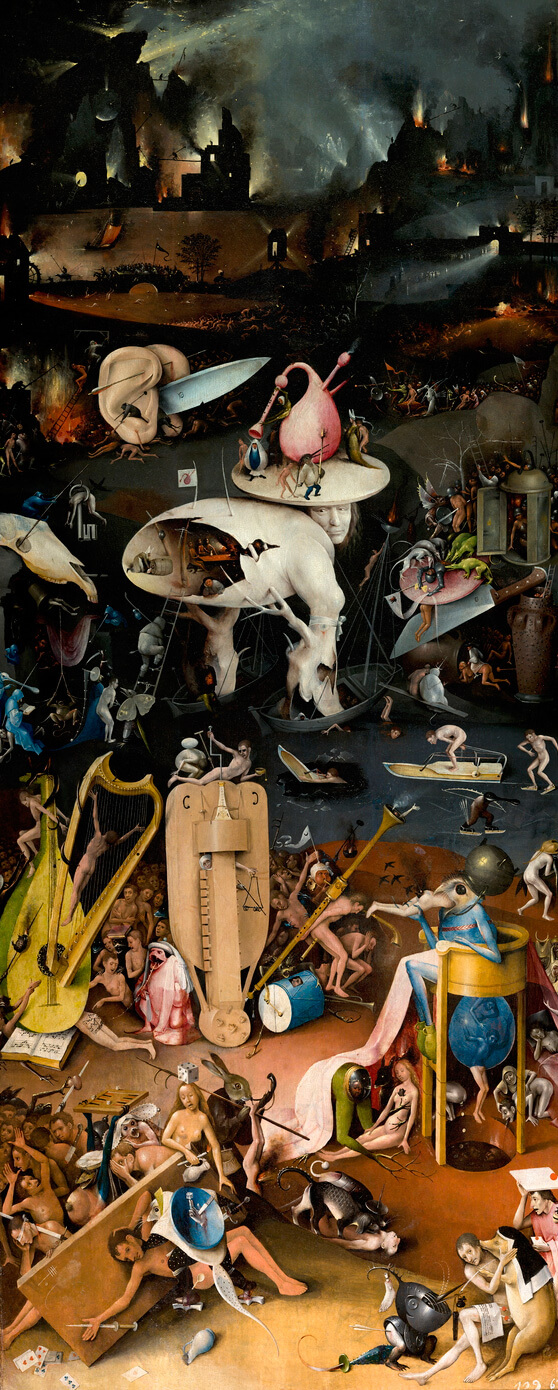
I have a concept that I call “the mural.”
When talking about systems and how they change, you have to avoid making the fallacy of reification.
This is where you treat an abstract concept as though it were a physical object. For example, time “travel” makes no sense because time is not an object that you can “travel through.”
So when you say that a system has changed, you’re really talking about the objects that make up the system. You’re looking at every single object in “capitalism” and treating it as one object.
And this snapshot is what I call a “mural.” It is the mural that changes.
So I had a pretty trippy idea about writing dialogue
I have this idea that what we call a “meme” or “idea” is actually a physical object. It’s an arrangement of matter that gets copied and then “shipped” via a “meme seed” such as sound waves, text, pictures, Braille etc.
Now consider this: a conversation is a system that can change. A conversation can start out cheerful, but become increasingly unpleasant as time goes on.
However, it is irrational for a concept to “change” or “evolve.” So when we say that a conversation changes, what we really mean is that the objects that make up the conversation change.
The sound waves begin to change their character, as do the arrangements of atoms in peoples’ brains.
So, this actually simplifies dialogue a lot. Because now you can think of dialogue as like an object that moves from person to person, getting changed with each interaction.
It’s like hot potato
Working on an outlining tool that I call Wine Closet. It’s like Excel except way easier for a writer to use.
https://claude.ai/public/artifacts/239f2f7d-d7dd-4c54-b9ed-10f2f64a6daf
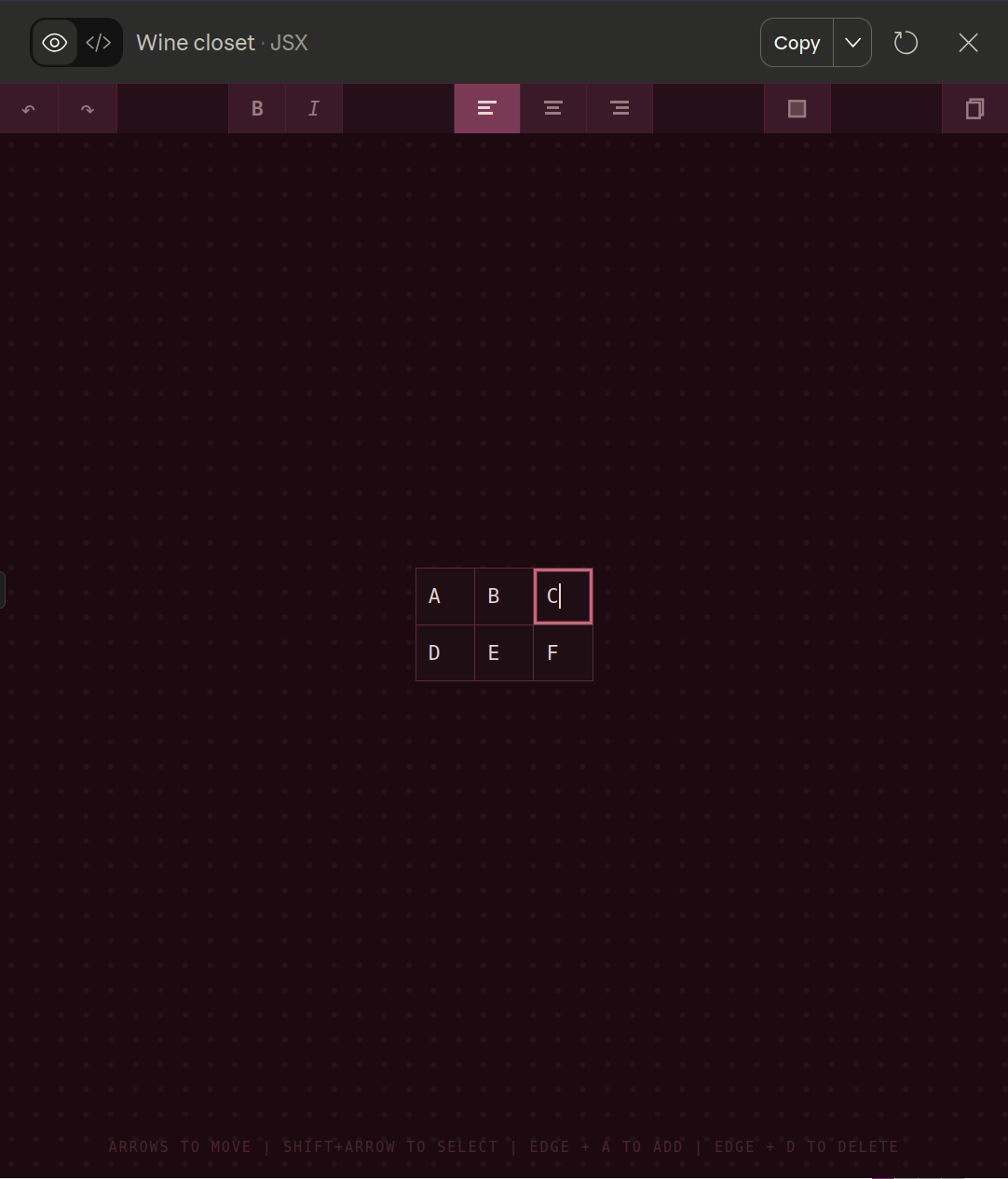
| A | B | C |
|---|---|---|
| D | E | F |
Any recommendations on an alternative to Google Docs?
CherryTree plus Google Drive for backups.
So I’ve been thinking about the complexity of plotting stories…
I had this idea I called the ‘locus of perfect.’ It is the object that a system perfects towards. It is very similar (probably synonymous) with Clotaire Rapaille’s ‘culture code.’
For example, the locus for an employer is his particular interests. He revises his routines to service this interest, and neglects everything else. Less pay for employees, less time spent with his family.
Well, a story is a system of suspense. Read from left-to-right to experience suspenseful events. And this suspense is “going somewhere” – it’s aiming at something.
So to massively reduce the complexity of the system, you establish your “peak” moments first. Create some awesome situations, and then plot / draft your way around them.
This is why erotica is easy to write: you want to get to the part where they mate. And this is also why comedy is easy to write: you want to put the story together to contextualize the jokes.
With a strong locus, every line is weighted in that direction. And so all of the complexities of plot, conflict, trauma, arcs, and so on become obvious.
When you construct an outline, there are bullets, but they don’t mean anything – they don’t cohere into a structure. It’s just one thing after the other. Even with a coherent foundation and well-written characters, it isn’t a story. Story means sequence + suspense.
You’re supposed to be revising your system towards that end: keeping the reader interested. Not worrying about the theme, or the dialogue, or the pacing. All of that stuff should come naturally with a proper locus.
If there’s a cool shootout scene, like in Predator, it doesn’t take a genius to weave all of the plot, theme, and character elements around that very special event.

This is to say that the REAL outline for the story should be like five bullet points. The rest can probably be outlined on the fly.
But the bullet points should NOT be abstract. They should be very vivid, and you should want to get to them.
Yeah I would say that’s solid. I am a little apprehensive though, because I think the bulk of the soul of a lot of great novels come from the gestalt of the mundane parts. That is probably something exclusive to novels because they can be anywhere from 300-1000 pages, pretty long. A movie tends to be pretty compressed.
I’m also not sure that ‘soul’ of a novel can be formalized. I think it might be something that emerges from spontaneous writing / the subconscious. That is why I do like pantsing as an approach, although that approach has its weaknesses for sure.
Honestly I think the best advice anyone has given about creativity / ‘the art life’ is David Lynch. And he doesn’t even know what most of the stuff he’s made even means, which I feel is the result of his own version of pantsing.
I think the core of art (good art) is something fundamentally mysterious, kind of like the human soul. I think that there are lots of good formalized approaches but I think that’s just a means to an end that you must have the proclivity (and talent) to reach regardless.
It’s more like: you have a few awesome parts that let you discover the other awesome parts. For example, you write a vivid scene with some pirates in a candle-lit inn. You squeeze as much detail out of that scene as possible, and that detail informs you about the adjacent scenes.
We live in a physical universe – there are only objects. Life means that an object moves unpredictably.
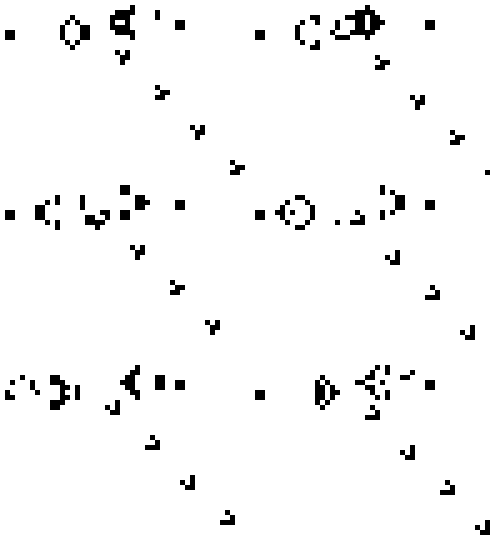
We like to imagine that life is magic. But to a sorcerer, there is no magic. A sorcerer understands how his ‘magic’ works.
This becomes especially clear when you study Bill Gaede.
Points where I would disagree:
We like to imagine that life is magic. But to a sorcerer, there is no magic. A sorcerer understands how his ‘magic’ works.
This is a pretty modern, Brandon Sanderson-esque understanding of what a sorcerer would think imho. Mystery schools had ‘mystery’ in them because they dealt with things that could only be experienced. That is literally what the word means in that context.
This becomes especially clear when you study Bill Gaede.
I appreciate Bill Gaede’s ideas the same way I appreciate a well-rounded magic system in a fantasy novel, or a well-crafted philosophical system. I am religious so obviously I am biased here, but I don’t really care.
Points I agree on:
It’s more like: you have a few awesome parts that let you discover the other awesome parts. For example, you write a vivid scene with some pirates in a candle-lit inn. You squeeze as much detail out of that scene as possible, and that detail informs you about the adjacent scenes.
Yeah that sounds about right, I agree with this approach.