This thread is self-explanatory.
Been thinking about this:
People say that you need to practice drawing for thousands of hours to get the shapes right. Ex: anatomical proportions, likeness, etc.
But does practice actually make some “muscle” stronger, or does it merely allow you to intuit simple rules?
For example, drawing fingers from imagination is really hard – they usually come out looking worm-like.
And you can practice these for hundreds of hours with references until you’ve got it down – but what did you get down?
Well, Japanese and Korean artists approach drawing instruction like this: they give you little rules.
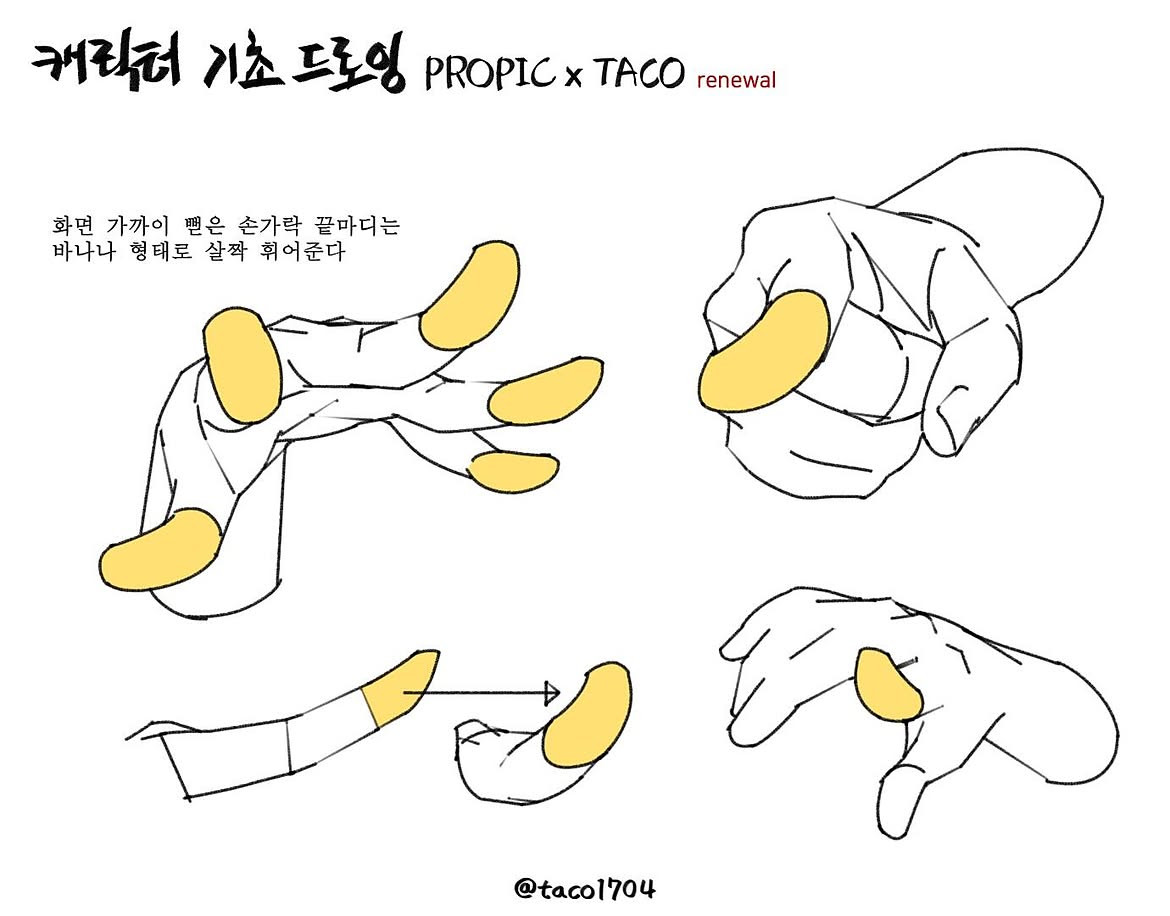
The bottom is round, but the top is flat, and the nail is curved like a cylinder.
There. Three rules, and you instantly know how to draw a believable finger. You can exaggerate, you can caricature, or get abstract – and the likeness is still striking.
So consider this: we can write all these little rules down. We can draw simple references to convey the idea. And so we don’t have to remember anything.
So what the hell is the point of practice? Why don’t we just access the material when we need it? Wouldn’t that make drawing a hundred times easier?
Muscle memory is misleading or a misnomer. You’re training your neuronal connections. idk why the name caught on. Practice isn’t necessarily about intuiting rules. You can endlessly practice incorrectly and end up reinforcing bad habits. By learning the rules alone, you won’t get far. You still have to practice. If I pick a random stranger off a street and tell him these rules, he will still be terrible at drawing. It’s also not a super effective shortcut because you have to find a rule for every single thing you draw, which takes time.
Knowing is knowing where to look it up. An academic with 10+ years of experience knows all the names of all the top authors in his field and is familiar with all the top publications and what they say. Compiling that kind of encyclopedic knowledge alone takes time and effort. He has it all in his head, and it’s often nuanced or you have to have special access to certain repositories. So you can’t just access the material unless you know where to reliably find it.
But practice is also useful on a more rudimentary level. If I take the average digital artist, they know all the Photoshop shortcuts by muscle memory. They don’t need any rules for those. Even taking a traditional artist like say Bob Ross, they’re familiar with the brushes, different techniques to use them, colors, how to hold a palette, how to not get all messy… it’s not as simple as dragging the brush into the color and then on the canvas.
In general, I’m sceptical of tutory as a concept. Just about anyone can become a blacksmith if they are born into such a family and simply learn it from their father. He doesn’t have to sit his child down or teach any rules. The child just picks it up naturally, even if the father is a mute.

Another example is in chess. Beginners get told to take control of the center, develop their pieces and castle. But kids rarely if ever follow those rules, even after being told a million times. I imagine the single best predictor for success in chess is simply practice and how much playtime you have accumulated (arguably with exceptions towards the GM level). Tyler1 is famous for brute forcing 10 min games all day every day for months on end until he reached a formidable ELO of around 1900 without ever learning any rules. He’s not the only one. The total playtime it took him to reach that ELO is very much average compared to someone who does learn rules, from what I know. So I’m not even convinced it helps all that much at all. Obviously it depends.
But even if you take a random stranger off the street and you give him all the time in the world to memorize all the rules of chess and read all the textbooks, he still won’t beat Magnus Carlsen if it’s his first game. Carlsen has something that he will never have, and that’s decades of experience and practice. The noob might even fail on something as simple as remembering to hit the clock after each move, a basic rookie mistake. Because no matter how often you read about remembering to hit the clock, you can only internalize it through practice.
Those fingers DO look really good.
They also look like chips. Yummy.
Visualizing something, illustrating it, but the illustration looks wrong. Not all of the fault is in the motion of the hand.
Sometimes you visualize something and experience it as a cohesive whole, but it still doesn’t correspond to a flat representation on canvas. The way your mind abstracts things can leaves holes that you can’t leave on a canvas, it leaves some choices unmade. You know the illusion where an upside-down face has a flipped smile, but you don’t perceive it. If you were marched away before the illusion slipped and told to paint the face, would your memory of your experience of the illusion expose the orientation of the smile to you? I think this will vary from person to person. I don’t think this is a unique effect. I believe simple familiarity with a mental image is not enough to perceive/remember/envision it in a truly flattened format. You have to go from your own unique perception-based format to a flat format, and that takes skill.
It is probably hard for you to notice the ways your memory of an image could correspond to several different actual images.
My big conspiracy about practice is this: practice creates intuition, but intuition can be understood rationally. So if you understand the intuition, you instantly master it.
So imagine a baseball player who sucks at aiming. He practices and practices and practices until one day, he gets a whole string of bullseyes. My hypothesis is that he intuited some rule or set of rules that he doesn’t rationally understand.
That by strengthening those brain connections, he creates a pattern that condenses into a rule. And this rule can be understood to create a superior aim.
Sleep generally matters. Even if you feel conscious during an all-nighter, your art brain isn’t.
If you can mentally conjure the image you’re going for with clarity in your mind’s eye, that’s a massive help. If you can, then flatten the very perspective from which you see it into a two-dimensional image, then simplify that into basic shapes. For figures I like to use triangles, pentagons, hexagons and septagons for the torso, and squares and octagons in place of circles.
Then recreate the details.
However, a good way to get out of art block is to try and take a different approach altogether, to see if things will ‘slide this way’ if they don’t ‘slide’ the normal way.
Is the Chick a reference to noobs or a reference to how Hens will chirp at their eggs and the eggs will chirp back? (Which is described as pre-hatch training by some)
The brain mainly operates unconsciously and irrationally. idk what “understanding” exactly is on a fundamental level, but you can’t insert a disk into your brain and upload the skill of basketball throwing. Importantly, the concept of “understanding” doesn’t apply to the cerebellum at all. But it does intuit in a way where “rationality” does not apply. It learns strictly through trial and error.
The chick is the quiet observer. It is “The Fool” in the Rider Waite Tarot deck. The prodigal son of the mute father. By sheer luck and intuition, they stumble upon the worm which is their physico-spiritual gold. The mammal is nursed by its mother, but the chick naturally knows how to walk the moment it is born. It is not defenseless. It attacks like a terrible tyrant all those sorrow-stricken Lindwyrms that crawl beneath its mighty beak. It is not for naught that in times of yore:
“Chicken wuz T-Rex n shieet”.
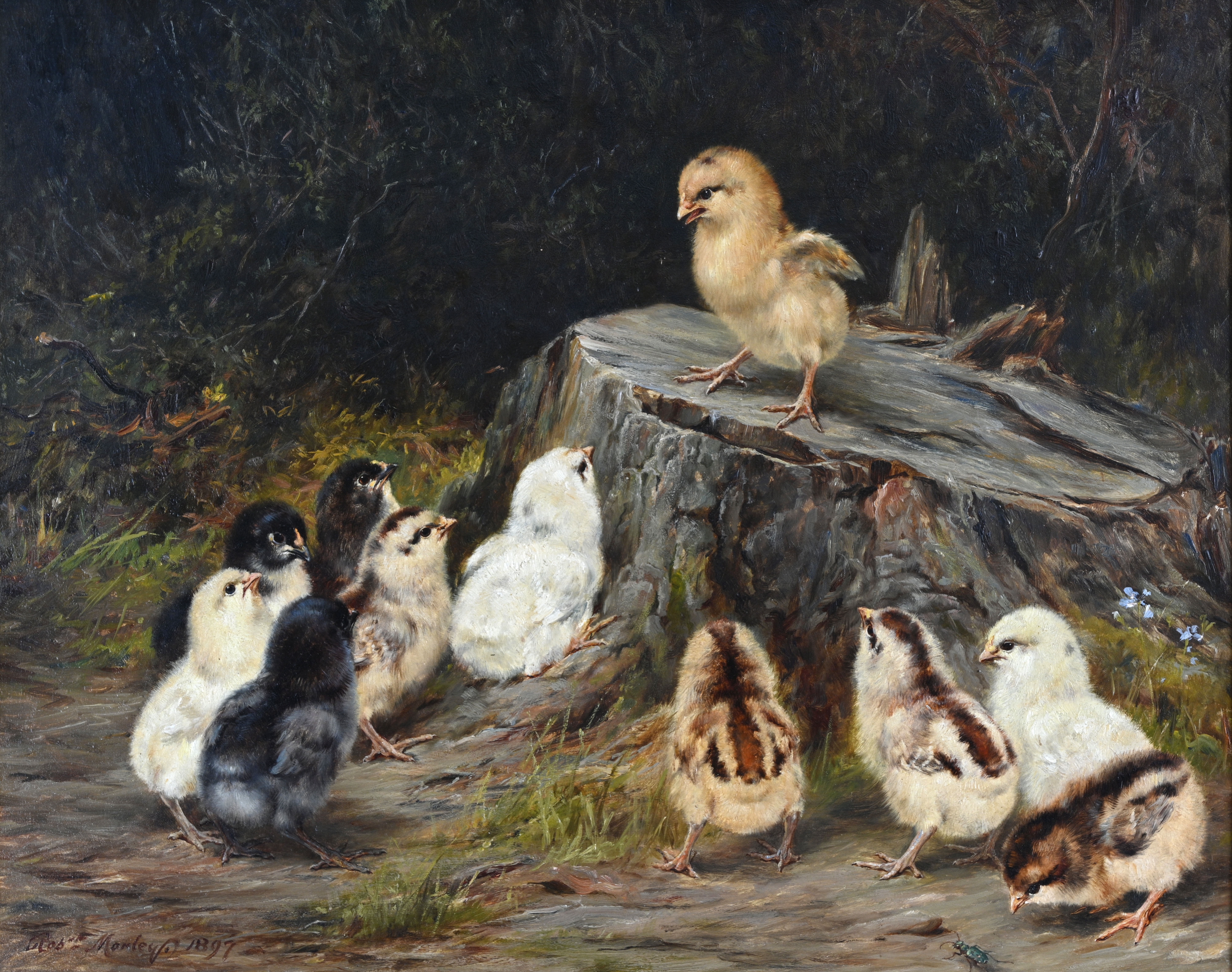
For truly I tell you, the chick is the mightiest among all bird-kin. What one man mistakes for a noob, another recognizes as unactualized potential. Pure potentiality, primordial Chaos. The ants tremble beneath its might. The yellow carriage of carnage ravishes across the grassy meadows as do the flames through a burning forest. It’s instincts are like a terminator’s programming, telling it to ravish upon the insects in the field. They hold the terror-bird’s beak, it’s claws, and it’s predatory eyes that laser focus on unwitting prey. They have stood here on these grassy fields in Æons long forgotten, and shall remain forevermore.
I remember something about mechanical skill-learning being a process in the basal ganglia, which is also blamed for regulating awareness/attention stuff sometimes. I believe I’ve heard it described as a shifting mass of circuits that learn things fast. It seems to be a partially conscious process for me.
I think you could probably design an advanced training system with a great, intuitive UI that helps propagate the physical truth of how the person is throwing the ball down into those unconscious processes. I don’t think that pulling the expertise out of the context where it does what it does will help hone it.
You know how your height shrinks slightly through the course of the day from a peak in the morning? You know how robots suck at balancing, even though they don’t have to compensate for that variable? It’s a chaotic process, slight changes in the conditions result in a vastly different pitch. The actual calculation an expert pitcher does must involve tons of tiny details like how compressed his spine is, how tight all these different muscles across his body are. My rational mind isn’t meant to process all that at once. But my unconscious mind might.