I made the mistake of getting to know a lot of Far-Leftists, between 2009 and 2012; aside from them showing up for their activism and their bullshit theoretical talks, I thought them a very lazy bunch. The young are crazy, and more utilitarian on theory, but utilitarian in a very obtuse way. The old, the red diaper babies, do actually have a clue, as to where they are in life, but they still can’t budge, on the one thing I thought would actually help them: changing their party to line to at least not implicitly alienate the majority of manual workers.
I could never understand why they could not do this.
Modern left parties in the West are no longer dominated by industrial laborers or trade unionists. They’re staffed by university graduates working in media, NGOs, academia, and public administration. These people have cultural and moral priorities ( anti-racism, gender rights, environmentalism ) that differ from blue-collar workers’ economic concerns. If I had my druthers, my proposed party line, if I could have proposed it more clearly would still have been rejected. Simply jettison all of your identity resentments so as not to incite the counter-resentment of Native Legal Workers who are being displaced and undercut by foreign labor. Is that too much to ask! This is all I would ask. But for that alone, that alone, to even suggest this in the slightest possible way is “racist” on the Left today. Why.
Most “progressive” institutions ( universities, NGOs, government contracts ) depend on grants, foundations, and cultural capital, not on mass worker dues. That makes appealing to those circles economically and reputationally safer than courting skeptical native laborers who might hold “unacceptable” views on immigration or social issues. The thing is, I would not even necessarily ask a good economics first, class first, Old school Leftist to “be racist, sexist or homophobic” just stop alienating actual workers by waving the Gay flag around, and acting as if “racism” against the foreigner is more of a priority in cultural interchange than “racism” against the native-born citizen worker. That is literally all I would ask.
But they can’t do this.
Since the 1960s, the left’s moral legitimacy has come from opposing “discrimination and hierarchy” rather than from redistributing wealth. That moral frame is emotionally powerful: it lets activists feel they’re fighting for justice rather than merely for wages. Moving away from it would feel like moral regression to them. This is of course utter bullshit, because there will always be hierarchy; and if you want to sell people on redistributing wealth, after the fact of your moral frame, the implication and even explication of this requires a justification of your new social hierarchy. Left-wing party elites, assume workers will “come around” once the moral argument is explained well enough, instead of seeing that cultural alienation is the main obstacle. This produces echo-chambers: leadership talks to people like themselves and doesn’t hear the shop-floor dissent.
Thus, they end up representing the educated professional class while claiming the language of labor. Hence their slogans are “progressive” but hollow to those of us who come from backgrounds, situations, jobs, towns, or identities that have been upended by globalization and migration. It just never made any fucking sense to me why the Left and Far-Left have to take this Internationalist “everyone is oppressed but Whitey” line, when they could take a far more reasonable position; such as that of the French PCF under Georges Marchais in the 1980s, that opposed cheap imported labor on class grounds. This, I foolishly thought, need not require being discriminatory, racist, sexist, homophobic at all. It would merely require prioritizing the people who are actually the first victims of the current process: your own fucking native-legal-worker class.
But the Left, cannot do this. For years I could not fucking understand why.
The Peter Turchin Answer
The far-left in modern Western societies is not primarily composed of dispossessed workers or revolutionary materialists, but of elite overproduction, an expanding stratum of “educated” individuals who cannot find positions of power, prestige, or purpose within the already-saturated moderate-left and liberal establishments. Their radicalization is driven less by genuine proletarian solidarity than by elite frustration, the structural exclusion of surplus aspirants from the existing “power chairs” in academia, media, and politics. In other words, there are simply not enough power-chairs among liberal or social-democratic, academia, media, and politics, which is why the Far-Left even continues to exist at all. The exist, as a kind of “kiddie table” or backup floppy disk, for whenever the existing power-chair holders die off, or need someone to come in. They exist, for the moment, mostly to be the canon fodder storm troopers, for “democratic riots.”
Within the left, the “moderate-liberal” elites occupy the institutional seats: universities, bureaucracies, NGOs, and major media. The frustrated younger or “ideologically pure” ( whether Communist or Anarchist ) cohort, often from the same class backgrounds, find no path upward. They radicalize and attack their own ideological family, becoming the far-left. Because they cannot gain power, they compete for moral status. This produces ever more extreme purity tests (“decolonize everything,” “abolish the police,” etc.), as radical moralism becomes a form of cultural capital, what Turchin might call a status competition mechanism among surplus elites.
The working class becomes irrelevant to this struggle, since the energy driving far-left politics is intra-elite rivalry, not class mobilization. The language of “the oppressed” is symbolic capital, a way for surplus elites to justify their own claim to moral leadership. As moderate elites try to preserve order and radical elites demand moral revolution, polarization widens. This is the phase Turchin associates with elite fragmentation, a precondition for increasing social crises. I think this is part of the reason why the Liberal cannot and feels it should not bother to “police the Left” as someone like Jordan Peterson would have. Because there is no point. It would be a little like the meek and mild “sinner” at the back of the Church complaining about an alter boy to the priest being Gay; You are causing a ruckus in your holy place, and ultimately the so-called “values of the far-left” are their new collective “holy place.”
My Theory of the Managerial Monarch vs. The Politically Engaged Leftist
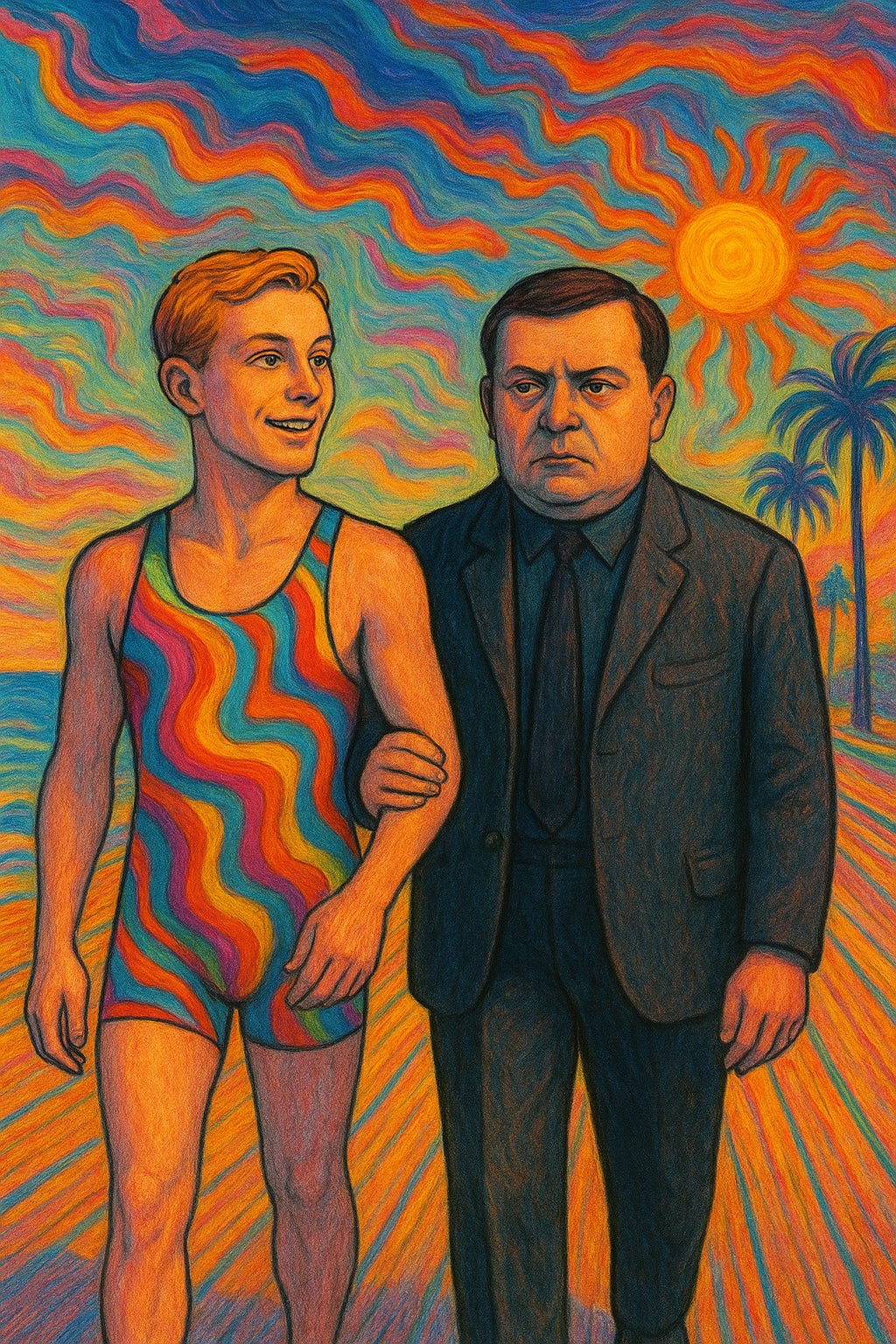
It just never seemed rational to me that the dour and puritan like, simple tunic wearing Economic communist could exist on the same wing as the Pervert communist. Yet they somehow do co-exist, and have coexisted for a long time. The Left has always been split between two instincts, bureaucratic control and moralistic activism.
How could it be, that men as dour, serious, conservative looking and puritan as a Malenkov, an Andropov, or a Brezhnev could coexist in the same leftist cultural-social ideological moralistic “party” as a Carl Wittman or a Harvey Milk. How could it be that the Left, can from one side of their mouth support Communist China; which is obviously just an excuse for Han Racial Supremacy by another name, and also support all kinds of weirdo predatory sexual rights in Western Countries. How can they do both at the same time. It just never made a lot of sense to me. To even ask the question, however tepidly is to incite the Leftist to moralistic rage.
One thought I had was that there was a departure in Russia between what could have been a dour closed-off isolated continuation of the dour puritan Managerial Monarchism of Stalinism under his likely prefered successor Malenkov, and instead, the Soviet Union took the International Moralistic Politizing Approach under Khrushchev, which ended in an arms race that the Soviets lost, but which retained the Leftist-Moralistic De-Colonization rhetoric, which simply served no useful purpose after 1991.
If Georgy Malenkov had managed to stay in charge after Stalin’s death, the Soviet Union’s path would likely have been more cautious, and bureaucratically repressive, but less erratic than Stalin’s, and without Khrushchev’s dramatic “Secret Speech” and thaw. Malenkov had a surprising moderate streak economically: He wanted to shift resources from heavy industry to consumer goods, improving living standards; however slowly. It would have been a more repressive and slower-moving version of modern-China, but it would have been stable, and would not have had to rely on the moralistic international posturing that Khrushchev dialed up, facilitating the rags of the modern Left. Without Khrushchev’s political energy, Malenkov might have been blocked by hardliners and retreated into cautious, committee-style rule. If Malenkov had prevailed, the USSR might have looked more like China under a never-reforming Maoist bureaucracy, grimly stable, quietly authoritarian, and ultimately brittle; but more importantly for me, there could have been less of a defacto association in the West, between Nazism, Fascism, and “the workers taking the side of their own nation.” Since Russia would be doing that, in all but name even more clearly to people for much longer.
Malenkov’s brief post-Stalin vision aimed to modernize the USSR by shifting focus from heavy industry and military buildup toward consumer goods, housing, and education, essentially “Deng Xiaoping without capitalism.” He wanted to raise living standards rather than expand empire. However, the Soviet system’s rigid planning, lack of market incentives, and bureaucratic inertia meant such reforms could only yield modest comfort, not dynamic growth. Unlike China’s later model of “socialism with markets,” Malenkov’s USSR would have achieved slow, equal, and stable progress but stagnated by the 1970s. In the best case, the average Soviet citizen might have reached a standard of living similar to 1980s Spain, humane and secure, but never rich or innovative. In other words, there would be lot less to differentiate them from the ghost of fascism, since the moralistic performative argument would have taken a back seat.
The regime would have looked more like an authoritarian welfare state: paternalistic, technocratic, and managerial rather than messianic.
But today, no matter what they pretend, “radicalism” among the far-left is less about class and more about status frustration within a surplus elite. The working class is increasingly irrelevant to their struggle; ‘the oppressed’ serve as symbolic capital, not actual allies. I was once told outright here in Canada, by some utterly crazy nutjob British immigrant Stalinist ( not even a citizen in my own country ) that all he wanted was a desk job in a Soviet regime. ) The same guy called me “petit bourgeois.” He looked like a gaunt un-handsome, very psycho version of David Tennent, without the sex appeal.