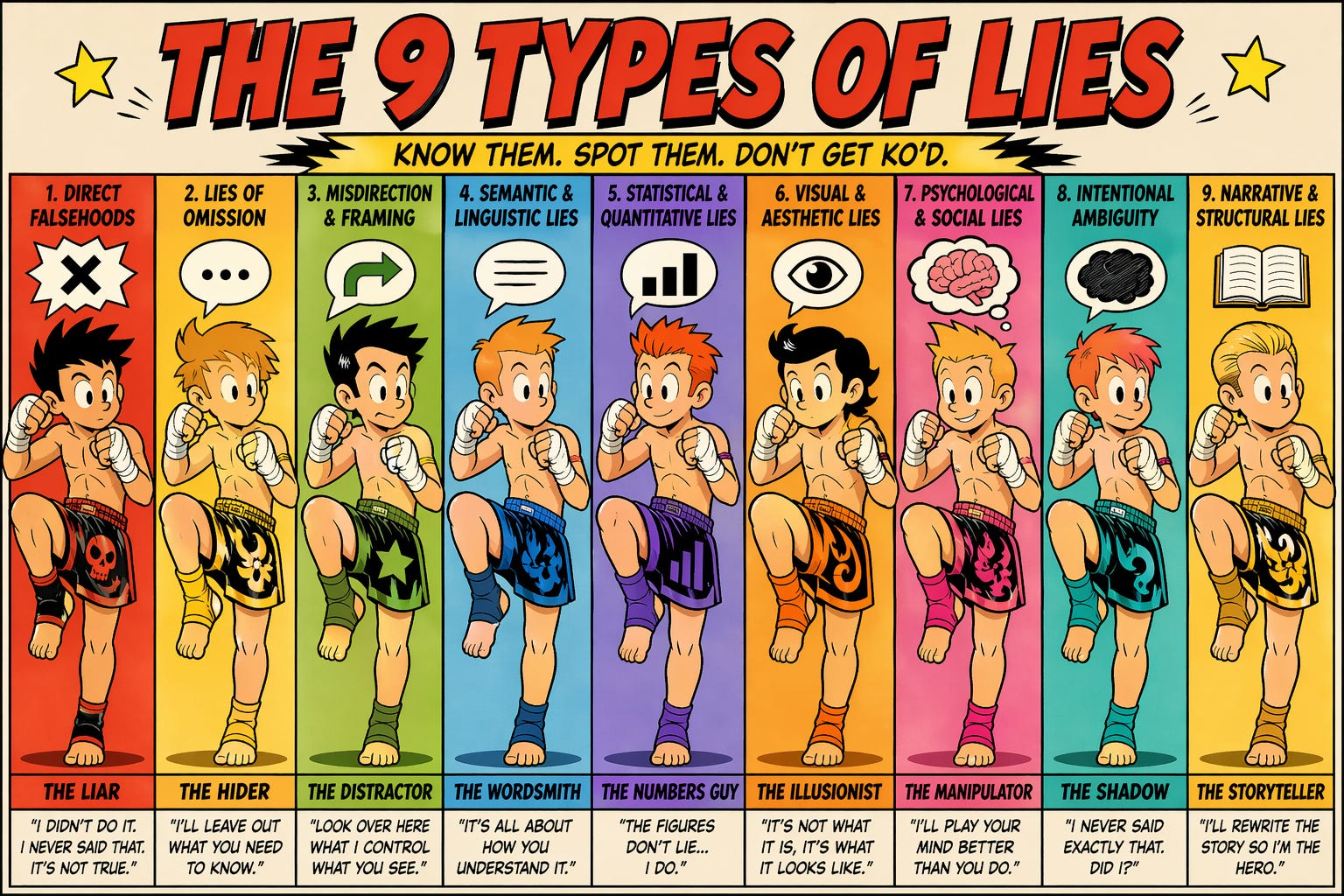
The 9 Types of Lies
Some of us can feel genuinely floored in life when we encounter people who are a lot more adept at subtle forms of deceptive framing and of being misleading with an intent to dominate and extract. In many cases we do not understand the tools that they are working with until much much later in life, so we adapt to the skilled liar in other ways; by making ourselves small, by playing humble, by focusing on inconsequential truths so as to not offend the liar with our suspicions. However with experience, we all eventually start cataloguing lies in an unsystematic way for the most part. We learn to get a feel for people and walk away when we do not like the cut of that man’s jib.
The problem is that life is complicated and it may serve those of us who do not come from situations where we were ever explicitly instructed in deception to watch, learn and categorize, how it is done. Naturally, many liars who think themselves intelligent, end up deceiving themselves, or they earn such a reputation that others learn to never believe a word they say, even if it is truth. This primer is certainly not a blanket prescription for lying, just the bare framework of a roadmap, for how most humans deceive. Deception is also not the same thing as a fallacy or a listicle of fallacies, since a fallacy usually has both intended and unintended truths mixed within them, while deception uses for intended purposes, both truth as well as un-truth, but always for a malevolent end.
I. Direct Falsehoods (Classical Lies)
Explicit lie
A politician says a policy will lower taxes knowing it will raise them. In a relationship, someone pretends greater success with the opposite sex, in order to be more popular socially; socially, a person lies about credentials, or pretends to test for other peoples credentials in order to establish a false reputation for caring about truth, while in reality is purely power seeking; religiously, a preacher claims to be about faith, but utilizes well-practiced psychological tricks for social control.
Fabrication
The utilization of slander techniques is another popular one; representing or getting someone misrepresent themselves in a certain way is a very common way to introduce a deception to lower someone else, while raising your own status. A friend fabricates being invited to an exclusive event; a partner invents where they were last night; a religious figure creates a testimony to inspire followers.
Denial
A government denies wrongdoing despite documented evidence. In social circles someone refuses to admit obvious misconduct, or alternatively making an accusing of misconduct to pressure you in concessions; in relationships a partner denies betrayal.
Exaggeration / Understatement
A leader inflates economic success or minimizes a crisis. People overstate achievements, or minimize others; in relationships someone downplays hurtful behavior; political rhetoric is used to demonize an opponent for instance who be against the harms that immigration causes, by accusing him of “violent rhetoric.” Meanwhile, the actual policy of immigration increases violence, but by penalizing and shaming resistance, you can exaggerate the unfairness of the reaction to displacement. This is done by maximizing sympathy for your favored groups, and demonizing your enemies.
II. Lies of Omission (Silence as Deception)
Omission
When someone in business tries to sell you on the benefit of something, while hiding the actual costs, and the actual hidden things he wants. A friend tells a story but leaves out their own fault; a partner omits meeting someone important; a religious speaker leaves out inconvenient passages.
Selective disclosure
A campaign shares only favorable data. In order to increase station, someone reveals only flattering details; in relationships a person shares partial truths; religious leaders highlight doctrines that support their authority.
Context stripping
A quote is used politically, religiously, historically, without its original context. A social media post removes background; a partner recalls only part of an argument; a religious text is cited without historical setting.
Half-truths
A statement is technically correct but misleading overall; the strategy of being misleading with truthful information is probably the most effective form of lying ever invented. A friend tells part of what happened; a partner tells the truth but not the whole truth; a preacher uses accurate facts to lead to a false impression.
III. Misdirection & Framing Lies
Misdirection
A politician shifts focus from a scandal to a minor issue. Socially, someone changes the subject when challenged; in relationships a partner deflects blame; ideological debates redirect away from doctrines that no longer apply to the current situation but carry with them a ritualistic purposes. You see this with a lot of the social-ideological lingo you see on the Left, which is virtually meaningless in a post 1991 context.
Framing
A policy is framed as “security” instead of “control.” Framing is a powerful tool, social events are described to favor one side; in relationships someone frames themselves as the victim and the other as the villain; religious teachings are framed to emphasize obedience. Even to simply deny the other side the right to speak, or the moral authority is a kind of frame, a preemptive frame.
Cherry-picking
A campaign selects only supportive statistics. In social interactions, someone recalls only favorable examples; in relationships one brings up only past mistakes of the other; religious arguments cite only confirming passages.
False equivalence
Two unequal issues are presented as comparable. In social presentation, minor mistakes are equated with major ones; in relationships one partner equates very different actions; religious debates compare unlike doctrines as equal.
Whataboutism
Criticism is deflected by pointing to another issue. In social competition, someone responds to blame by accusing others; in relationships a partner shifts focus to past grievances; religious debates deflect with unrelated examples, or even by not mentioning other just as valuable and illustrative counter-examples.
IV. Semantic & Linguistic Lies
Equivocation
A word is used in multiple meanings to confuse. When a dominating person deals with people less adept, ambiguous language avoids clarity; in relationships someone shifts definitions mid-argument; religious discourse redefines key terms like “truth” or “sin.”
Loaded language
Emotionally charged words distort perception. In matters of social psychological control, labels influence judgment; in relationships words are chosen to provoke guilt; religious rhetoric uses emotionally powerful terms to guide belief.
Euphemism
Harsh realities are softened through language, in order to please or elevate one at the expense of another. Socially, failure is rebranded as a “learning experience” in relationships; wrongdoing is minimized; religious and ideological institutions soften controversial practices, statements, policies, or disasters in the past in order to justify their persistence in the present.
Weasel words
Vague phrases create misleading impressions. In matters of interpersonal power, statements lack accountability; in relationships someone avoids commitment; religious claims rely on “some believe” without evidence.
Technical truth
Statements are true but misleading in effect; this is an extremely powerful form of lie which is very hard to distinguish from truth. Socially, facts are used without context; in relationships someone answers truthfully but evasively; religious claims are structured to be defensible but deceptive.
V. Statistical & Quantitative Lies
Misleading statistics
Numbers are used to imply false conclusions. Socially, data is presented selectively; in relationships someone uses numbers to justify behavior; citing statistics without taking into account other issues, such as per capita, presentation issues, comparability problems between two data sets, endogeneity, survivor bias, and personal experience,
Base rate neglect
Underlying probabilities are ignored. Socially, rare events are treated as common; in relationships isolated incidents are exaggerated; religious claims ignore broader context.
Graph manipulation
Visual data is distorted to mislead. Socially, charts exaggerate trends; in relationships evidence is presented selectively; religious presentations use visuals to reinforce claims.
Correlation vs. causation errors
Unrelated events are linked as cause and effect. Socially, coincidences are treated as proof; in relationships blame is misplaced; being successful and then correlating that success exclusively with someone’s own brilliance or competence, without taking any other factors into account.
Sample bias
Unrepresentative data is generalized. Socially, limited experiences shape broad claims; in relationships one example defines a pattern; religious beliefs are based on selective cases.
VI. Visual & Aesthetic Lies (Appearance-Based)
Image manipulation
Images are altered to change perception. Socially, photos are curated; in relationships appearances are staged; careful perception management can of course be a kind of lie, baring in mind that the intent is to turn the lie into truth over time. This is where we get a serious grey area between to what degree is someone genuine, and to one degree do they merely see every interaction as staged or managed.
Symbolic framing
Visual symbols imply meaning beyond facts. Socially, status symbols shape perception; in relationships gestures are staged; religious settings use symbolism to convey authority.
Halo effect
Attractiveness or status influences perceived truth. Socially, good appearance equals credibility; in relationships charm hides flaws; religious leaders gain trust through presence, and not being contradicted. Conflict lowers the halo effect, maintaining power without critique is one way of maintaining your Halo effect. This is one reasons ( I suspect ) for while Leftists being so shrill, when anyone on the Right understands them enough to “talk back” to them. It is for the same reason, that religious people do not appreciate unanswerable questions.
Set design deception
Environments are curated to influence perception. Socially, spaces are staged; in relationships settings are used to impress; religious environments create a sense of legitimacy.
Costume signaling
Clothing conveys authority or identity. Socially, attire signals status; in relationships presentation shapes impression; religious dress reinforces perceived authority.
VII. Psychological & Social Lies
Appeal to authority
Claims rely on authority rather than truth. Socially, people defer to status; in relationships one partner asserts dominance; religious figures claim legitimacy through position.
Bandwagon effect
Popularity is used as proof. Socially, trends dictate belief; in relationships consensus pressures agreement; religious movements emphasize widespread acceptance.
Gaslighting
Reality is distorted to undermine perception. Socially, someone denies obvious facts; in relationships a partner manipulates memory; religious texts may be invented in order to justify practices that the leaders desire to indulge in.
Moral framing lies
Actions are justified as morally good. Socially, behavior is reframed positively; in relationships harm is justified; religious rhetoric frames actions as righteous.
Fear-based distortion
Fear is used to manipulate perception. Socially, threats are exaggerated; in relationships fear controls behavior; religious teachings emphasize consequences to enforce belief.
VIII. Intentional Ambiguity & Plausible Deniability
Ambiguous statements
Statements allow multiple interpretations. Socially, people avoid clarity; in relationships someone speaks vaguely; religious teachings leave room for interpretation.
Strategic vagueness
Details are deliberately omitted in order to create an unearned aura about a person, or to obfuscate past crimes which have lowered station and opportunity in life. Socially, commitments are unclear; in relationships promises lack specifics; religious or ideological claims remain broad to remain unobjectionable, until they bring you in, and you begin to see the much more precise designs which may if anything completely contradict the selling strategy.
Dog whistles
Messages target specific audiences subtly. Socially, coded language signals groups; in relationships hidden meanings are conveyed; some terminology and lingo can communicate messages that speak differently, and are understood differently, between insiders and outsiders.
Plausible deniability
Statements are crafted to avoid accountability. Socially, people avoid responsibility; in relationships intentions are obscured; religious leaders avoid direct claims.
IX. Narrative & Structural Lies
False narrative construction
Facts are arranged to create a misleading story. Socially, stories are shaped selectively; in relationships events are retold to shift blame; the creation of false narrative construction of the past in order to serve current narratives. Ignoring that cannibalism, wife burning and slavery were common place in all parts of the planets, prior to the British Empire, but then condemning them for failing to live up to their own laws. This is a powerful deception which millions of people can be conditioned in.
Causal distortion
False cause-and-effect relationships are implied. Socially, outcomes are misattributed; in relationships blame is misplaced; religious explanations assign incorrect causes. By assigning incorrect causal relationships for things you can delegitimizing other people, while aggrandizing yourself. A good recent example of this would be the Jordan Peterson remark about “unearned Iranian oil wealth.” A causal distortion he would have rightly condemned if it was made from the Left about American or European technological innovations.
Hero & villain simplification
Complex situations are reduced to simple roles; if someone is on one side of the issue he is evil, if someone is on your side, he is always good; no one on your side can ever do anything bad, only the other side can do bad. Socially, people are categorized; in relationships one is cast as the villain; religious narratives simplify moral conflict.
Temporal manipulation
Events are reordered to change meaning. Socially, timelines are altered; in relationships events are recalled selectively; reality is reinvented to support a utopian racial vision. A good example of this is the idea of the “noble savage” or the notion of Europeans spreading homophobia and rape culture to the cultures of the planet that never had concepts for things they did casually in many cases.
Most people think a lie is simply a false statement. That is a child’s definition.
The adult reality is far more dangerous: lies are systems of perception control. The most effective deceivers do not rely on crude falsehoods. They omit, they frame, they select, they soften, they exaggerate, they aestheticize. They construct an environment in which the truth becomes irrelevant, because the audience no longer knows where to look. At that point, deception is no longer an act, it is a structure of reality itself. The question no longer becomes, “Is this true?” The question becomes: “Who benefits from this being believed?” This is where most people stop thinking and where serious analysis begins. This is where we must start asking new questions about lies:
Which groups benefit the most from ambiguity, vagueness, and plausible deniability becoming the dominant modes of speech?
Which elites rely on statistical manipulation and technical truths to maintain legitimacy without accountability?
Who gains power when language itself becomes unstable, and definitions shift depending on the speaker?
What kind of person or groups will thrive in an environment where appearance overrides reality, and perception can be curated at scale?
And perhaps most importantly: who is systematically disadvantaged when truth must compete with narrative, framing, and emotional conditioning?
These are not moral questions. They are questions of structure, of incentives, and of power. Because once you understand the forms of deception, you begin to see something else: not everyone lies in the same way, and not everyone lies for the same reason. Some lie to avoid punishment. Some lie to gain advantage. But the most dangerous lie is told by those who have learned to reshape reality itself, not just describe it. At that stage in the game the lie becomes a tool to reshape reality itself or a way to “change the world,” as the cunning social progressive might say.