Managers control Nets; “capitalists” rent boats
The parable of the Nets and the Boat: Who Really Runs the Economy?
Reality has moved on from the simplistic understand of politics and economy which “the Left” broadly speaking believe in implicitly or explicitly. Whether are are talking about the now broad liberal-social-democratic leftist mass of precarious voters, or the tiny remaining hard Marxist-left, which I might otherwise have had some initial respect for in theory. We no longer live in a world where workers have real staying power over industry in any way; a situation which once briefly existed in the 1900s of Britain, France and Germany. Today, the Leftist class analysis is utterly neutered and does not represent anything real or coherent; it is an unclear, inaccurate picture of reality.
James Burnham produced a much more accurate picture of reality, in which, if anything, the managerial classes, wield actual power and control over the political economy and its direction. The “capitalists” might “own” the boats, but ownership is less meaningful in a post-industrialized world. Burnham’s insights explain something people already sense intuitively; the simply fact that bureaucrats really run things, executives of companies, hedge funds, institutions really make the decisions and owners are much more distant.
Managers despite not being owners, can technically control the direction of capital itself. They control investment decisions, hiring, strategy and production. This makes the capitalist, who once seemed the apex of the system, something that in many cases takes a backseat as a rent receiver in the system, rather than someone who has systematic control. This tendency was already recognized by the sociologist Robert Michels in his famous “Iron Law of Oligarchy.” Every complex organization eventually concentrates power in the hands of those who run it.
My Analog
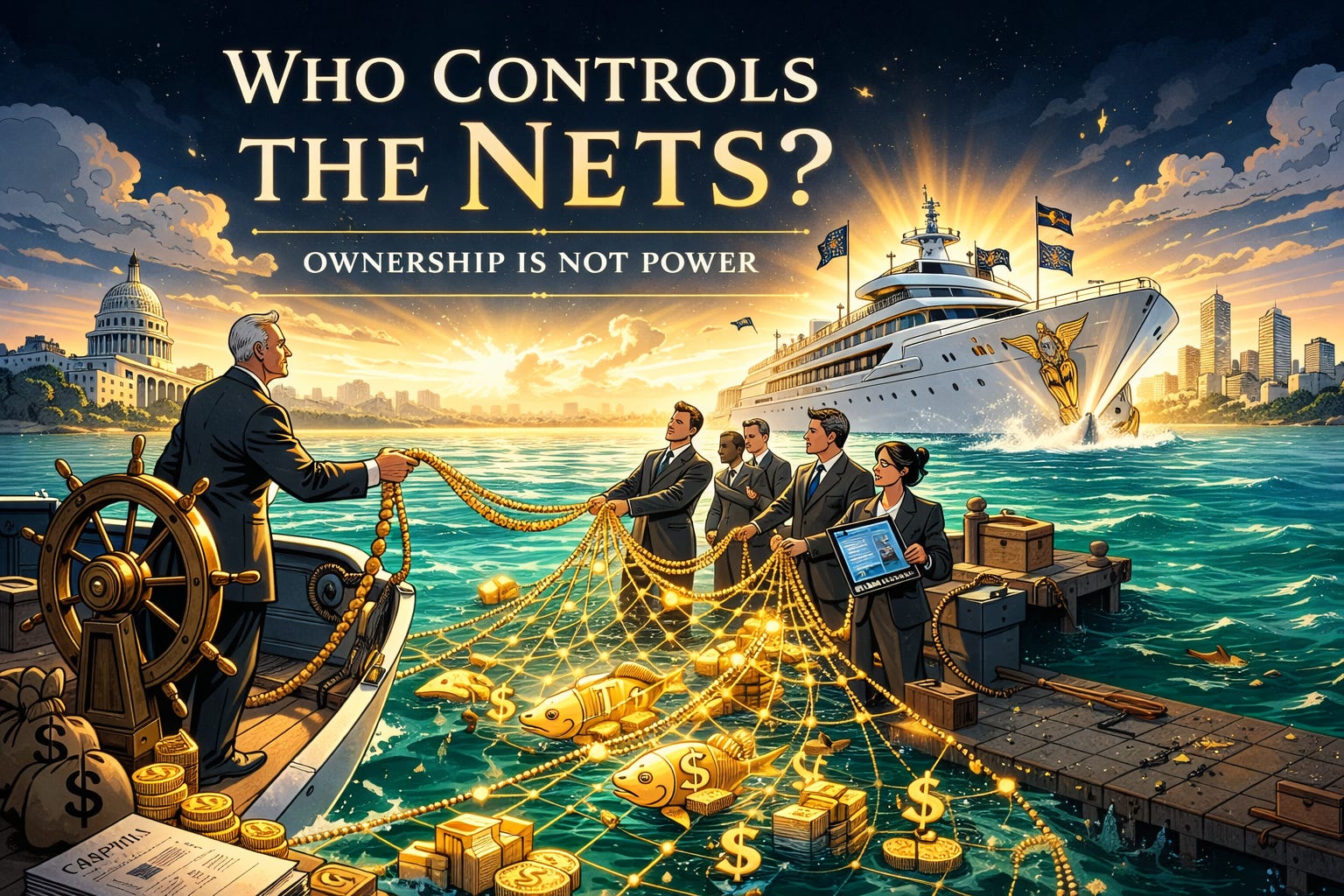
The picture is simple: those who own the wealth command the economy in appearance only, but ownership alone does not determine what actually happens inside large institutions. A better image might come from fishing.
The capitalist may own the boats. The boats are expensive, impressive, and necessary., but the real outcome of the industry, depends on the nets. Whoever decides where the nets are placed, how they are deployed, and when they are pulled in determines what the boat ultimately brings home.
Managers are those nets. Executives, administrators, planners, and bureaucrats decide how institutions actually function. Even when they do not own the vessel itself, they control the mechanisms that determine results. In practice, the boat may belong to the capitalist, but the catch depends on the manager.
Why Burnham Describes the Modern System Better Than Marx
The political theorist James Burnham argued in his book The Managerial Revolution that the modern world was no longer governed by traditional capitalists alone. Instead, power was shifting toward a new ruling stratum: managers. These were the executives, administrators, technical experts, and bureaucratic elites who actually operate the institutions of modern society.
In Burnham’s analysis, legal ownership becomes less important than operational control. Shareholders may formally own corporations, but executives make the real decisions. Investors may supply capital, but administrators decide how resources are used. The same pattern appears in government, the military, universities, and large organizations of every kind. What matters is not who owns the institution on paper, but who controls its machinery.
From this perspective, capitalists resemble owners of ships, while managers command the fleet. Governments, corporations, and large bureaucracies all become part of the same managerial system. The people who run these structures, those who decide strategy, policy, and operations, gradually become the real nodes of power. Ownership remains visible, but control increasingly belongs to those who manage the nets of the system itself. Burnham’s was that in complex societies, power follows those who control organizations. Ownership may remain visible, but the ability to direct institutions determines who actually governs.
Control shifts from ownership to management when operational authority is delegated
In the case of Les Wexner and Jeffrey Epstein, Wexner granted Epstein power of attorney for a period of time. Legally, that meant Epstein could act on Wexner’s behalf in financial and business matters. In institutional terms, that is an example of how delegated authority can give someone practical control over assets they do not own. This is another example of my analogy, the capitalist may own the boat, but if he hands the nets to someone else, that person dominates the actual decisions of what is done with the boats and its catches.
The lesson is the mechanism: modern institutions often concentrate power in the hands of people who manage systems, not necessarily those who legally own them. That’s the phenomenon thinkers like James Burnham were describing when they argued that operational elites, executives, administrators, and bureaucrats, gradually become the real hubs of decision-making in modern complex organizations.
The case of Les Wexner granting Jeffrey Epstein power of attorney illustrates the mechanism is seen for us in miniature. Wexner remained the legal owner of his fortune, but operational authority was delegated to someone else. Once authority over decisions is transferred, practical control is what actually matters.
Final Analogy
A capitalist can insert himself among the managers like a Tzar controlling boyars, but it is the boyars who ultimately control the armies and can usually compromise the Tzar, especially in a liberal democracy, especially in an already industrialized society. They manage the system, they have entrenched institutional interests that the capitalist may not always have. Therefore in practice they have operational power, which can counter-man capitalists who may themselves not be intellectually focused or entrenched enough to even know enough to hire and fire those who would grant them the control they might want.
In the modern Left-capitalist system, many so-called capitalists may not even care that much about control; this is why managers form a natural controlling elite. Capitalists become passive participants, not the necessary top of the ladder. It is rare, if anything when a hybrid class of manager-capitalists appear, and even then, they do not have full institutional control over all the other managers. Capital alone rules nothing. Power belongs to those who control organizations and direct resources.