The Commissar Is Just a Kulak Who Doesn’t Farm: At Least the Kulak Grew Something.
Communism did not abolish exploitation; it gave the exploiter an office, a title, and immunity from failure
“Economic and political control is monopolised by the bureaucracy.”
—Bruno Rizzi, The Bureaucratisation of the World (1939)
“The exploitation of certain strata of the population by other strata has not disappeared, but has been disguised.”
—Leon Trotsky, The Revolution Betrayed (1936), Chapter 6
“The communist bureaucrat is the most dangerous type of bureaucrat. Why? Because he masks his bureaucracy with the title of Party member.”
— Joseph Stalin, Speech Delivered at the Eighth Congress of the All-Union Leninist Young Communist League (May 16, 1928)
“The enterprise comes to be thought of as existing for the sake of its managers—not the managers for the enterprise.”
— James Burnham, The Managerial Revolution (1941)
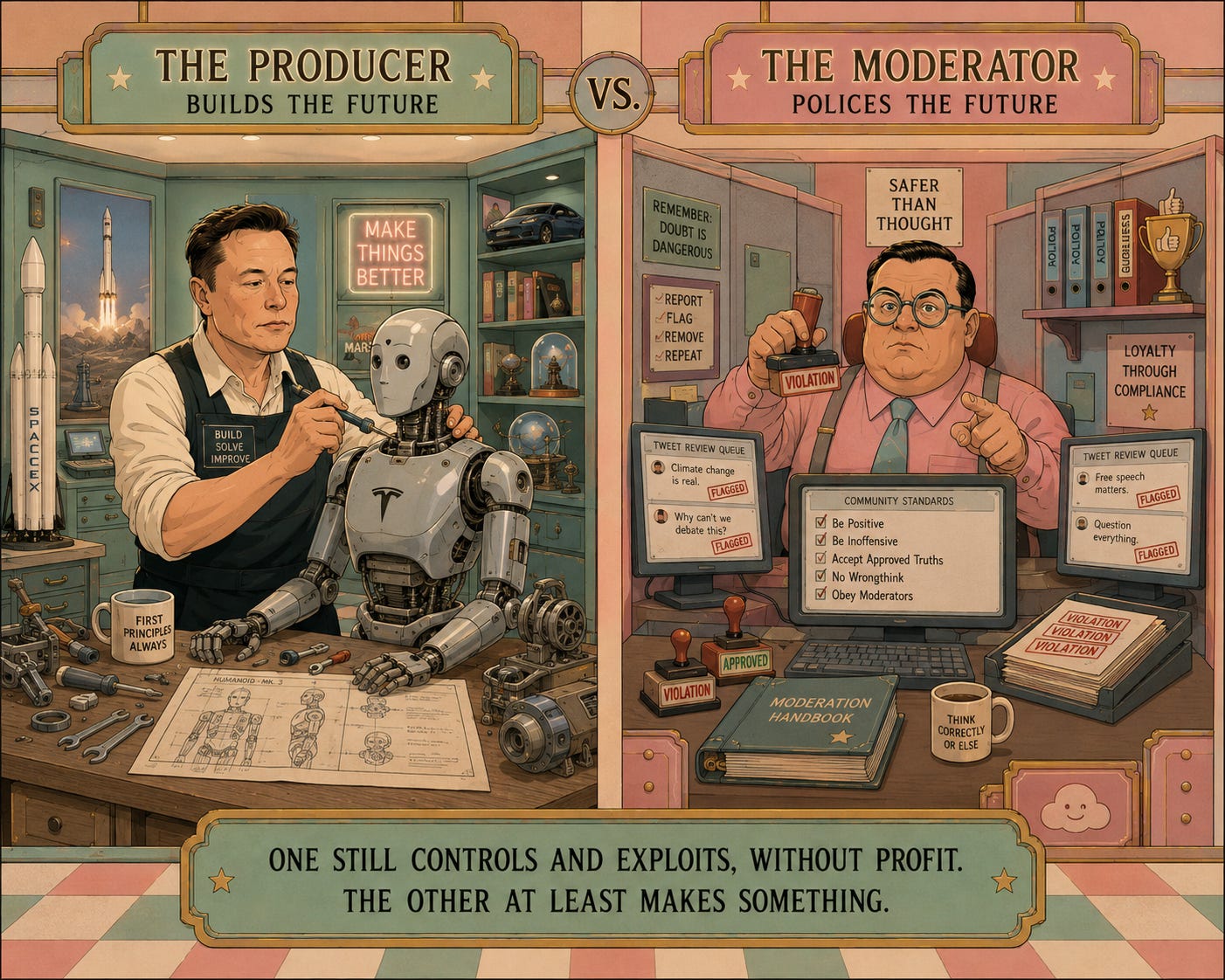
The Communist sneer of “petite bourgeoisie” has always struck me as one of the greatest pieces of envy-laden, covert narcissistic, class misdirection in the Leftist vocabulary. The sneer converts modest independence into moral corruption and political suspicion. My question for Leftists, is this: Why is the man who earns money by producing something morally categorized as an “exploiter,” while the salaried institutional intermediary who can regulate, prohibit, punish, blacklist, or distribute resources is presumed innocent simply because his authority isn’t called “property?”
For a brief opening clarification, yes, I am aware that kulak had a much more specific historical meaning in the Russian context; I will not be claiming that every small proprietor, student, or comparatively fortunate worker would historically have qualified as one. I use the term here in the looser polemical sense in which it is deployed by contemporary far-leftists: as an ideological slur for those deemed insufficiently dispossessed, excessively independent, or simply more “privileged” than the speaker’s preferred proletarian archetype. In other words, I am deliberately using the category as my opponents themselves often stretch it, rather than pretending that this modern usage is historically precise.
The Personally Productive vs. the Big Centre and the Powerless
The small proprietor, small owner, independent tradesman, shopkeeper, or successful peasant is treated as a uniquely contemptible creature: too prosperous to qualify as an authentic worker, too small to command the respect afforded to a great capitalist, and too independent to be safely controlled by the revolutionary machine. His modest success becomes evidence of moral corruption; not intelligence. Strip away the polemical category, which is often stretched far beyond any stable economic definition, and what remains is precisely just another “worker,” who has partially escaped destitution and accumulated some land, tools, equipment, savings, rental income, or productive capital, whether through work, intelligence, inheritance, or luck. ( And pure Bilbo Baggins “luck” was all I ever personally had. ) It is simply not consistent with the Marxist materialist analysis that many far-leftists claim-to-hold, to politicize and moralize, any case of mere luck, admittedly so, when many other cadres make no so weighted admission.
Does the thoughtful communist really believe that, because a man does not display his scars, he has none? Or that because someone claims the status of the oppressed, the claim must therefore be genuine? From a position of political weakness, such assumptions are especially self-defeating. In his closing speech to the Nineteenth Party Congress on October 14, 1952, Stalin argued that the Western bourgeoisie had “flung overboard” the banners of bourgeois-democratic liberty and national independence, and that Communists should pick them up if they wished to win the majority. Whatever one thinks of Stalin, the strategic lesson is difficult to miss: it is absurd to penalize the admittedly fortunate worker merely because he has escaped some hardships, possesses something worth defending, or enjoys enough security even to entertain your theory. If every difference in fortune must instead be transformed into a totalizing moral biography, privilege on one side, oppression on the other, one has to ask whether the doctrine is still explaining social reality, or merely giving ideological form to envy. This is what I think incites the envy of the dependent communist functionary, even if he is objectively more privileged in the eyes of that “privileged worker; it is not analysis, it is a personal gripe, taking the place of analysis.”
I am not suggesting that historically every such proprietor was an innocent saint. But neither was he necessarily a miniature Rockefeller terrorizing the countryside. Often, he was simply the man who had managed to build something durable. Communism promises to eliminate the social power represented by this figure. However, and this is the important problem, I want the Left to hear: you cannot eliminate the functions he performs. Someone must still organize production, maintain equipment, distribute supplies, supervise labour, keep accounts, decide priorities, and plan for the next season. The revolution may abolish the proprietor, but it cannot abolish management. It therefore transfers these functions to officials. This is why simply accusing some of immorality the minute he departs from the party line, is not evidence of a non-proletarian class analysis, for me.
In this contrast, I see the Communist argument reversing itself. The “kulak” is condemned because his control over productive resources supposedly permits him to dominate others. However, his replacement, the commissar, collective-farm chairman, party secretary, planning official, or desk-bound middle manager, is given still greater control over resources that he did not create and does not personally own. He may determine who receives machinery, credit, housing, employment, rations, permits, or political protection. He owns less on paper while commanding more in practice. He has control. Which is exactly the Weber-Burnham, observation. These roles do not always coincide: ownership, management, technical competence, and physical labour can be divided among different people. My point is that abolishing the proprietor does not abolish any of these functions; it merely determines who will exercise them and to whom that person will answer.
Two forms of Power
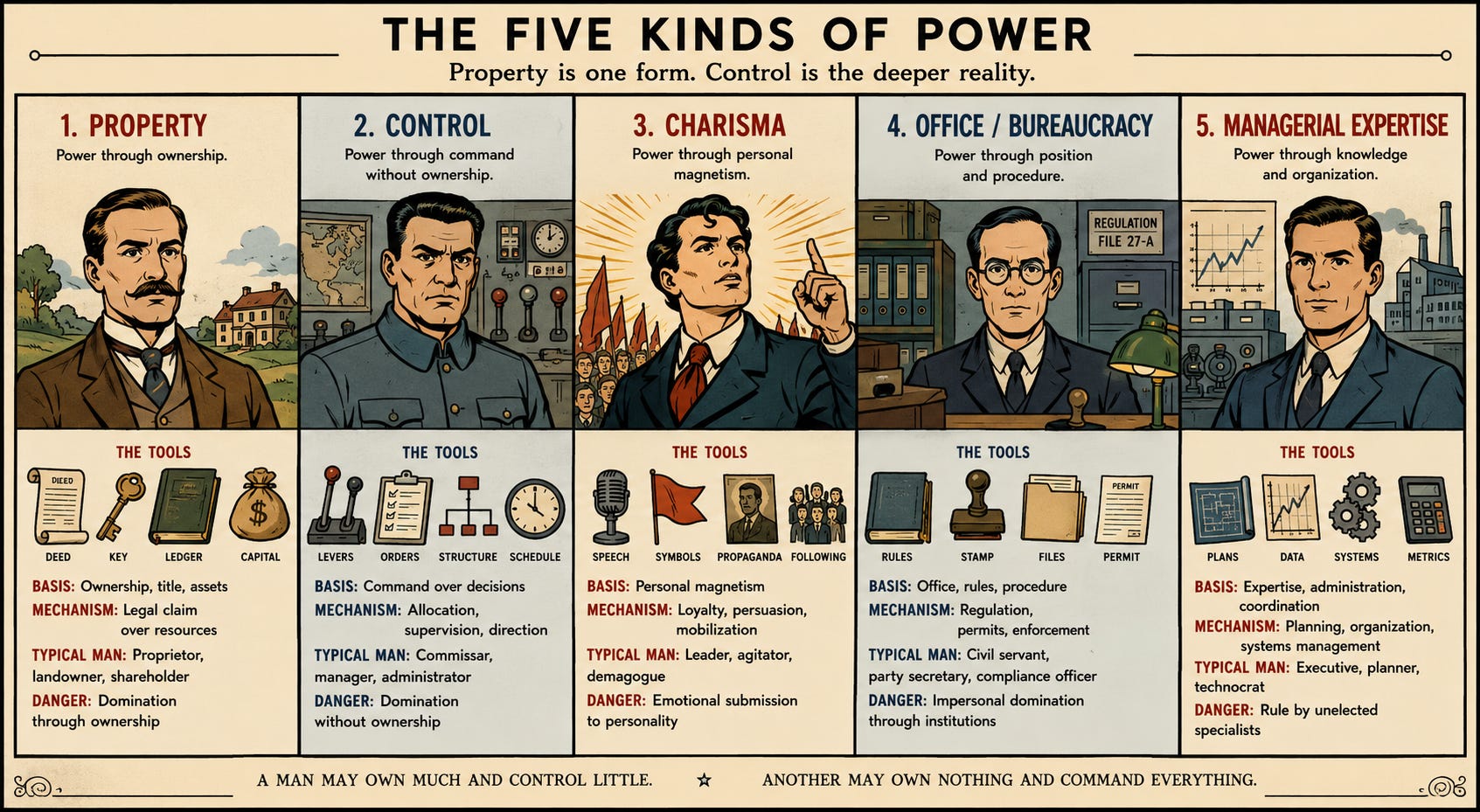
I am not dismissing the Marxist point that property matters, nor do I deny that property itself is a historical development. My objection is that property is only one form of power; control is more fundamental, and existed long before modern property relations. Hitler did not “take power” because he possessed property. He took power because, slowly but surely, he acquired control. His charisma was central to that process, and charisma is itself a far more primordial source of power than legal title or economic ownership. The Marxist error is in treating a comparatively recent, highly formalized, and specifically European juridical-economic expression of power as though it exhausted the category itself. Modern property is codified: it is expressed through deeds, contracts, shares, accounts, titles, and legally enforceable claims. But human beings exercised domination long before power could be represented by a document, entered into a ledger, or calculated on a balance sheet. Chiefs, priests, conquerors, military commanders, patriarchs, bureaucrats, and charismatic leaders have all exercised enormous power.
Hitler did not acquire power because his name appeared on a title, a piece of paper, or beside numbers on a balance sheet. He acquired power because his charisma produced loyalty, loyalty produced organization, and organization produced control. Indigenous peoples of North America, possessed their own systems governing territorial use, exclusion, and political authority without reducing those relationships to modern market valuation or transferable fee-simple title. Control of resources is older than the accounting systems through which modern societies represent ownership. Control, then, is a primordial form of power; property is one of its derivatives and institutionalizations. The central weakness in Leftist analysis is that it attacks one historically contingent mechanism through which control is exercised while remaining strangely silent about the underlying phenomenon itself. Abolish private title, and the question does not disappear.
I therefore see considerably less difference between the Communist bureaucratic middle manager and the “petty-bourgeois” proprietor he replaces than Communist theory wants me to see. Both occupy a position between the ordinary labourer and the highest governing elite. Both organize resources, direct other people’s work, and receive some benefit from their intermediate position. The crucial difference is that the kulak’s authority rests partly upon property, competence, and demonstrated production, while the commissar’s authority rests primarily upon his appointment by the political hierarchy.
Put more brutally: the commissar is just a kulak who does not even have to farm. That does not mean that every kulak was industrious or that every Communist official was lazy. Administration is real work, and some administrators are indispensable. My objection concerns the system of accountability. The independent farmer who repeatedly mismanages his land eventually loses income, property, or standing. The bureaucrat who mismanages agriculture may falsify his reports, conceal shortages, blame “wreckers,” demand additional resources, or punish the people who reveal his failures. One answers, however imperfectly, to production; the other answers primarily to the hierarchy above him.
Communism therefore does not abolish the middle stratum. It changes the basis upon which membership in that stratum is awarded. Economic independence is replaced by political dependence. The small proprietor must satisfy customers, creditors, workers, neighbours, and the material requirements of production. The functionary must principally satisfy his superiors. This makes bureaucratic conformity, ideological reliability, and institutional loyalty more important than ownership, and devastatingly, and dangerously: more important than competence.
Nor does the absence of private legal title abolish class power. If I cannot legally sell the factory, but I decide who manages it, who works there, what it produces, who receives its output, and who is punished when the plan fails, then my lack of a deed does not make me powerless. Ownership is one form of control; administrative command is another. Communism mistakes the abolition of the first for the abolition of the second. Indeed, the bureaucrat’s power may be more extensive precisely because it is disguised as public service. The proprietor admits that the farm or workshop belongs to him. The official claims to possess nothing personally while deciding who receives everything. His privilege is presented not as privilege, but as the necessary exercise of collective authority. It consequently becomes harder to identify, criticize, or remove.
The moral inversion is extraordinary. The peasant who accumulates the fruits of production is denounced as a parasite, while the official who confiscates, counts, distributes, and consumes those fruits is proclaimed the representative of the producer. The person who builds a durable household is accused of betraying his class; the person whose livelihood depends entirely upon the state hierarchy is celebrated as politically advanced. From my own producerist perspective, this is intuitively almost always a nearly backwards; especially in the modern world, where average “workers” have less and less control, and have to watch their mouths on political topics just to avoid being “fired.” We are less free now, than under Monarchy, which could not monitor everything you said and thought. Modern institutions possess capacities for reputational damage and employment control that premodern monarchies could scarcely have imagined. Formal liberties can therefore coexist with a cruel degree of constant surveillance.
My own solution
This is why, I would rather disperse property among workers, families, farmers, and small enterprises than concentrate all practical control in an administrative caste. The answer to excessive private power is not to make ordinary people permanently dependent upon officials. It is to give more people property, bargaining power, productive capacity, and a genuine stake in the institutions upon which their lives depend. The officials should exist only to ensure that the spread of that productive capacity remains spread and does not concentrate. The officials charged with preventing economic concentration must themselves be divided, audited, removable, and denied discretionary control over individual livelihoods. Otherwise, the institution created to disperse private power will merely concentrate public power.
The problem with “Communism” is that it does not finally eliminate the class relations it condemned. It dispossessed one intermediate class and manufactured another. It replaced the independent proprietor with the dependent administrator, the productive middleman with the political middleman, and visible ownership with less visible managerial control. The commissar was therefore not the opposite of the kulak; he is the kulak’s political successor: a middleman with fewer formal property rights, far greater coercive authority, and considerably less direct accountability for whether anything was actually produced. The central problem for me, is that there is nothing in the Leftist repertoire of recommendations, that guarantees an elimination of “inequality.” All it does, is transform the mechanism of “inequality” which is precisely the issue. The central and most important question from the point of view of the “equalist” should be that “ownership and control” are not identical. There is a difference between who formally owns an institution vs. who actually controls it, and who can punish whom. Without, asking this question, “inequalities” are not lessened.
As a final remark, the sophisticated Leftist will point out, that everything that I have said about the professions they tend to occupy, can be applied to corporate executives too. Certainly. None of this means that managerial domination is uniquely Communist. A privately owned corporation can also develop a salaried administrative caste increasingly insulated from its workers, customers, shareholders, and productive purpose; Burnham’s point was considerably broader than the Soviet case. My objection to Communism is more specific: by combining political sovereignty with administrative control over production, employment, allocation, and often housing itself, it risks concentrating in one hierarchy powers that a plural economy at least leaves divided among several institutions.
References
Burnham, J. (1941). The managerial revolution: What is happening in the world. John Day Company.
Đilas, M. (1957). The new class: An analysis of the Communist system. Frederick A. Praeger.
Michels, R. (1915). Political parties: A sociological study of the oligarchical tendencies of modern democracy (E. Paul & C. Paul, Trans.). Hearst’s International Library. (Original work published 1911)
Mises, L. von. (1944). Bureaucracy. Yale University Press.
Rizzi, B. (1985). The bureaucratization of the world: The USSR—Bureaucratic collectivism (A. Westoby, Trans.). Free Press. (Original work published 1939)
Trotsky, L. (1937). The revolution betrayed: What is the Soviet Union and where is it going? (M. Eastman, Trans.). Doubleday, Doran & Company. (Original work published 1936)