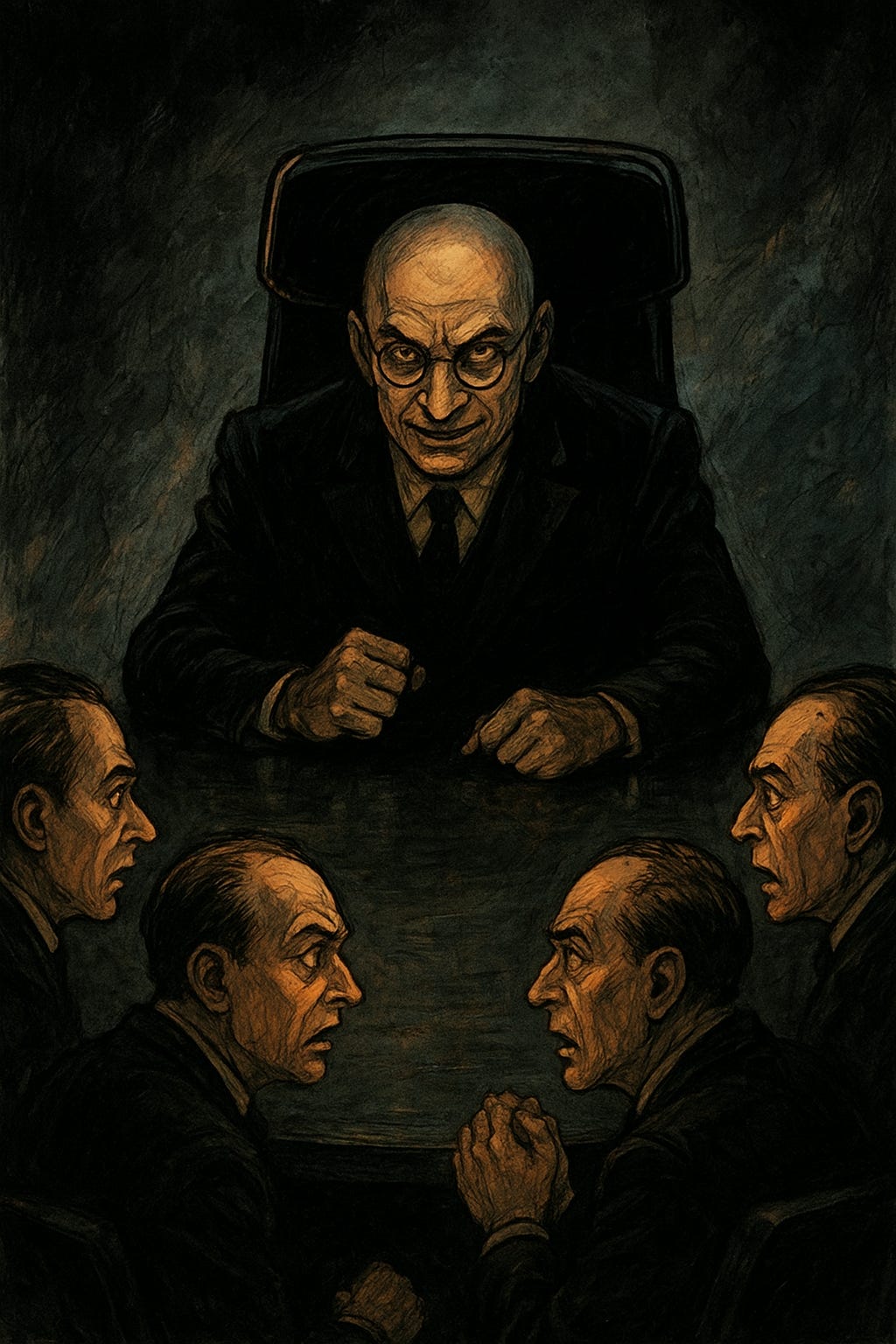
“He who controls all levers invites the hands of many to strike him down; conceal your strength, and you rule unseen.”
The art of rulership is not merely the acquisition of power, but its management in the minds of others. History is littered with those who were feared, not followed, and those whose omnipotence provoked preemptive strikes. A wise ruler understands that true authority is exercised invisibly, that fear of your power often inspires the coalition that will remove you. The lessons of Lavrentiy Beria, among others, illustrate the perils of appearing too strong, and the methods by which one may hold dominion without provoking mortal envy.
Narrow Loyal Base
“A throne balanced on one pillar falls swiftly when the pillar bends.”
A ruler who relies solely on the loyalty of one institution or class is a king perched upon a single pillar. The MVD, the army, the courts, if all allegiance flows from one channel, the threat of coordinated opposition looms. When all see that your power is concentrated and contingent, even your closest allies may betray you at the first whisper of opportunity. Those who hold only the security apparatus or the treasury are vulnerable; their indispensability is apparent and terrifying.
“Divide the roots of loyalty, and the wind of betrayal cannot topple you.”
The best way to solve this is to expand your web of loyalty across multiple domains. Ensure that ministers, generals, and party officials feel invested in your survival. Disperse patronage, cultivate friendships, and integrate the ambitions of others into your design. The ruler who survives does so not because he rules alone, but because others believe their fortunes rise with his continued power. Diversify your dependencies so that no single defection can topple you.
Beria failed precisely here. His throne rested upon the brittle loyalty of the MVD, one pillar of terror without roots in broader institutions.
He never wove himself into the fabric of Party, army, and state; he ruled through dossiers and fear, not shared purpose.
When Stalin died, his control over the police made him formidable but isolated. The generals despised him, the Party distrusted him, and the bureaucracy prayed for his fall.
Thus, when the moment came, no one stood between Beria and the bullets, because no one’s fortunes depended on his survival.
Overexposure of Omnipotence
“The man who shines with all the light blinds the eyes that must serve him.”
Power displayed openly is power resented. To parade your control over armies, prisons, or strategic secrets is to mark yourself as a target. The vigilant eyes of your colleagues measure not just capability but threat. Absolute knowledge and unassailable coercion are virtues for the ruler, but deadly when visible; omnipotence is a provocation.
“Let others lift the banners while you guide the wind behind them.”
To solve this you must hide the levers that move men and states alike. Let deputies and ministers appear as decision-makers; let your hand guide events invisibly. The wise ruler understands that to be feared openly is to be envied, and to be envied is to invite preemptive violence. Cloak your authority in institutions, rotate visible power, and cultivate an aura of moderation. Let others think themselves capable while you remain indispensable.
Beria’s omnipotence was his own advertisement. He strutted through Stalin’s corridors as master of secrets, arbiter of life and death, and reveled in the terror of others.
But he forgot that the powerful have long memories and short patience for humiliation.
His visible dominance after Stalin’s death, releasing prisoners, boasting of reforms, commanding the security organs, made him the most obvious target in Moscow. Every gesture that might have soothed suspicion instead broadcast control.
The man who had built the invisible machinery of fear could not make himself invisible when it mattered most.
Lack of Gradual Consolidation
“The river carves the valley not by force, but by patience.”
The ambitious ruler who moves too swiftly alarms both peers and subordinates. Sudden reforms, rapid promotions, or immediate accumulation of all levers create suspicion and invite coalition. In the instant that one appears unstoppable, the wise counteract; they strike preemptively. Impatience is a visible weakness masquerading as strength.
“Let the tide rise slowly, and no man will resist its flow.”
A good ruler must appear to ascend deliberately, in measured increments. Let influence grow like a slow tide, barely noticed until it reaches inevitability. Each step should appear natural, sanctioned by tradition or procedure, while subtly increasing your grip. Power consolidated gradually is seldom resisted, because it appears less a threat and more a consequence of circumstances. Time is the ally of discretion.
In the weeks following Stalin’s death, Beria lunged for the throne as if the empire were unguarded. He moved too fast, restructuring ministries, freeing political prisoners, speaking of liberalization, all under his own name.
Each action, rather than calming, confirmed to others that he meant to crown himself. Power, taken so abruptly, alarms even the ambitious. His rivals, sensing his impatience, joined in swift conspiracy.
What patience might have secured by slow encirclement, he squandered through sudden grasping.
His ascent was too visible, his ambition too fresh; the tide rose before anyone could believe it was natural.
Insufficient Co-optation of Rivals
“He who rules alone invites the shadows of the ambitious to gather against him.”
A ruler who relies solely on fear, authority, or competence alienates peers who might otherwise be allies. Those who feel excluded or threatened often unite against him. Beria, for instance, commanded terror, but not loyalty beyond his immediate network; thus, his colleagues combined to remove him. Isolation is a mortal enemy of power.
“Give others their place in the sun, and their warmth will protect you from the cold of envy.”
Therefore a good ruler must delegate symbolic authority to rivals. Let them shine in matters they care about, while quietly steering outcomes behind the scenes. The ruler must appear to share, without surrendering control. He who cannot even appear to share effectively, invites hatred. By integrating rivals into the architecture of power, you convert potential enemies into stakeholders in your longevity. A shared throne is a safer throne than one built solely on fear.
Beria made no friends, only subordinates and prisoners. He could blackmail any man, but he could not persuade one.
Khrushchev and the marshals of the Red Army united not out of ideology but mutual fear.
Had Beria shared real influence, given the generals symbolic command, let Party secretaries claim victories, he might have divided them. Instead, he offered nothing but servitude under surveillance.
The others saw that if he won, all would be subjects of the secret police. So, for once, they cooperated, and the master of division perished for failing to divide his enemies.
Poor Management of Public and Elite Perception
“He who marches loudly announces the drumbeats of his own fall.”
The ruler who appears overambitious or self-serving provokes envy and mistrust. Acts of apparent benevolence, reform, or reformist zeal are interpreted as vehicles for personal glorification if poorly framed. Reputation is the silent lever upon which survival depends. To act without regard for perception is to give your enemies a cause to unite against you.
“Govern in shadow, let the eyes see moderation, and the mind will serve you unquestioned.”
A good ruler cannot forget how he appears in the public narrative and in the private narrative; the narrative of rule. Display moderation, restraint, and loyalty to the collective, even while accumulating influence privately. Let the public and elite believe that your actions benefit the state rather than yourself. Subtlety is power; indispensability is perception, not display. The ruler who governs invisibly yet effectively commands longevity, while the omnipotent who is feared openly courts demise.
Beria never mastered the stagecraft of modesty. He had the intellect to rebuild an empire but the vanity to demand credit for every stone.
His gestures of clemency were seen as cynical; his reforms, as opportunism. The Soviet people feared him, but no one trusted him.
He seemed the face of tyranny in new clothes, pretending reform while tightening control. His arrogance poisoned his reputation faster than his deeds could redeem it.
In politics, perception kills faster than bullets, and Beria was executed by the image he had built long before the firing squad took aim.
The Paradox of Authority
“The hidden hand holds the crown; the crown that glitters is soon torn.”
The art of rulership is the mastery of appearance as much as reality. True power requires instruments, loyalty, discretion, patience, and perception. To wield it openly, to appear omnipotent, is to invite the coalition of the frightened and envious.
To wield it subtly, to integrate rivals and mask your dominion, is to command in silence, invisibly yet unassailably.
History is replete with those who fell because they were too feared; wisdom lies in holding dominion that others do not perceive, until it is too late to resist.