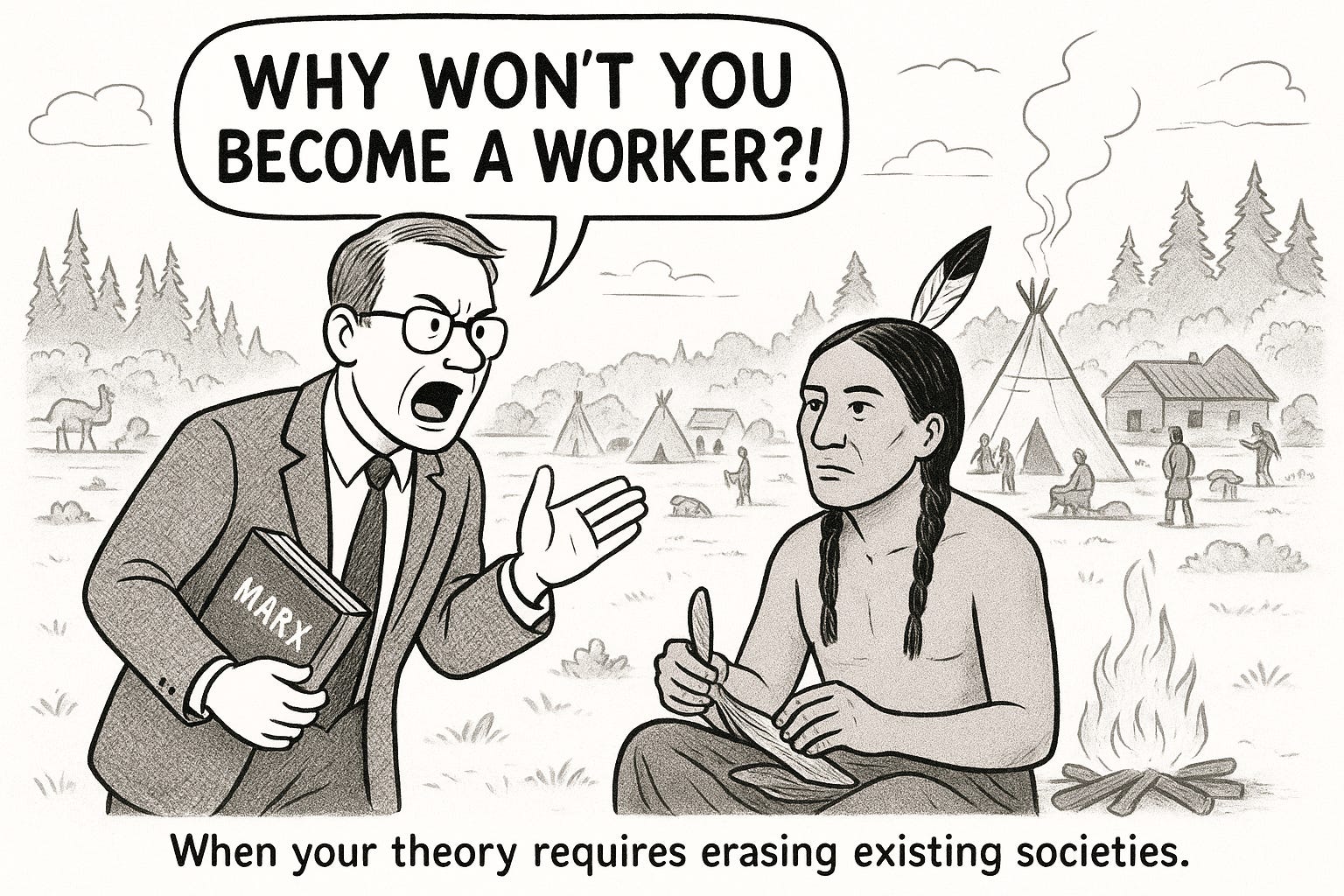
How Marxists and Leftists, Assume the Primacy of European Suffering During the Industrial Revolution
Classical Marxism unintentionally universalized the moral and structural priorities of early European industrial societies, treating proletarian wage labor as the central axis of historical injustice even though most human societies, past and present, organized suffering, obligation, and power through very different social forms.
Marxism still assumes that proletarianization is the “truth” of history, even where it has barely happened. Marxism took a local European pathology of early industrial capitalism and mistook it for a universal human trajectory. This is one reason Marxist revolutions outside Europe had to be radically reinterpreted.
That’s where the Eurocentrism lives. And modern Leftists are extremely confused, self-confusing and confusing of others, when they both sneer that they are the future, and the logical trajectory, while also rejecting and idealizing the fantasies of “peaceful” pre-capitalist non-European societies.
For Leftists, mass murder, tribal warfare, ritualistic rape and cannibalism either does not exist or is to be unspoken of in non-European societies. You may not use the word “primitive” in regards to them, or “advanced” in regards to your own model of society. However, when “critiquing” past “White” European societies, Leftists have no problem with using words like “primitive,” “backward” or “proto-fascist.”
The idea that the exploitation of wage labor is the central moral crime of history only really makes sense in places like Britain, northern France, and western Germany after factories, clocks, cash wages, and urban proletariats already existed. Marxism quietly assumes this situation is not an anomaly but destiny. That’s the sleight of hand.
The human norm is peasants, tenant farmers, artisans, and shopkeepers: people embedded in family, village, patronage, religion, and inheritance. They suffer, yes, but not primarily as “workers,” and not in ways that generate proletarian consciousness. Their grievances are about famine, rent, taxes, conscription, debt, land loss, or imperial extraction, not “alienation from the means of production.” Treating them as merely workers-in-waiting is not materialism; it’s European projection.
Why Marxists bristle, and why the critique still holds
To be fair, Marxists will protest that Marx wrote about peasants, that Lenin and Mao centered them, that dependency theory and world-systems analysis rejected linear European timelines. Fine.
But the deeper assumption remains: that proletarianization is the truth of history, even where it has barely occurred or produces nothing like the expected moral psychology. Marxism keeps smuggling in a European industrial moral hierarchy and calling it scientific inevitability.
The petty producer problem ( where the theory really breaks )
This is where Marxism quietly panics: the petty producer. The shopkeeper, the farmer, the self-employed tradesman, people who are simultaneously exploited and exploitative, autonomous yet fragile, conservative without being “bourgeois.”
Marxists and Leftists generally need to come up with all kinds of dismissive insults for this group of people, because they cannot be neatly fit in their theory; because they both have freedoms and certain conditions of coercion and constraint.
They do not line up neatly on the capital–labor axis, they don’t behave like good revolutionaries, and they stubbornly refuse to see wage labor as the central tragedy of existence.
Entire societies are built out of these people, which is why Marxist movements outside Europe had to be radically reinterpreted, disciplined, or coerced.
So the charge isn’t “Marxists ignore peasants.” It’s worse. They acknowledge them, then subordinate them to a moral story that only really made sense in a few 19th-century European cities.
That’s unintentional Eurocentrism with footnotes, and it still shapes how Western leftists talk about “the masses,” “false consciousness,” and why everyone inconveniently refuses to act like a factory worker from Manchester in 1848.
The Problems of the Modern Western Left
Marxism mistakes a historically specific rationalization of labor for a universal human condition; meaning, people don’t naturally organize their moral lives around economic abstraction unless culture, religion, and bureaucracy force them to.
Leftists forget that markets, and wage labor itself, are artificial institutions violently imposed, not organic expressions of human society. Most peasants actively resist being legible, certified, time-bound, sedentary, literate, proletarianized, or “liberated” into someone else’s theory of progress.
And this is where my critique shifts from Marx to modern Western leftism: today’s left often inherits Marx’s moral map without his historical caution.
It talks endlessly about “workers” while being staffed by academics, NGOs, and public-sector professionals whose worldview emerged from post-industrial Europe and North America.
The result is a politics that moralizes labor abstraction, scolds peasants and shopkeepers as reactionary, and remains baffled, utterly baffled, when most of humanity declines to experience its suffering in properly European terms.