The Problem Communists Cannot Answer
Revisionists and Reality: The Internal Crisis of Communism
“Politics is not a struggle of ideals, but a struggle of power.”
- James Burnham
The Internal Divide: Two Kinds of Communists
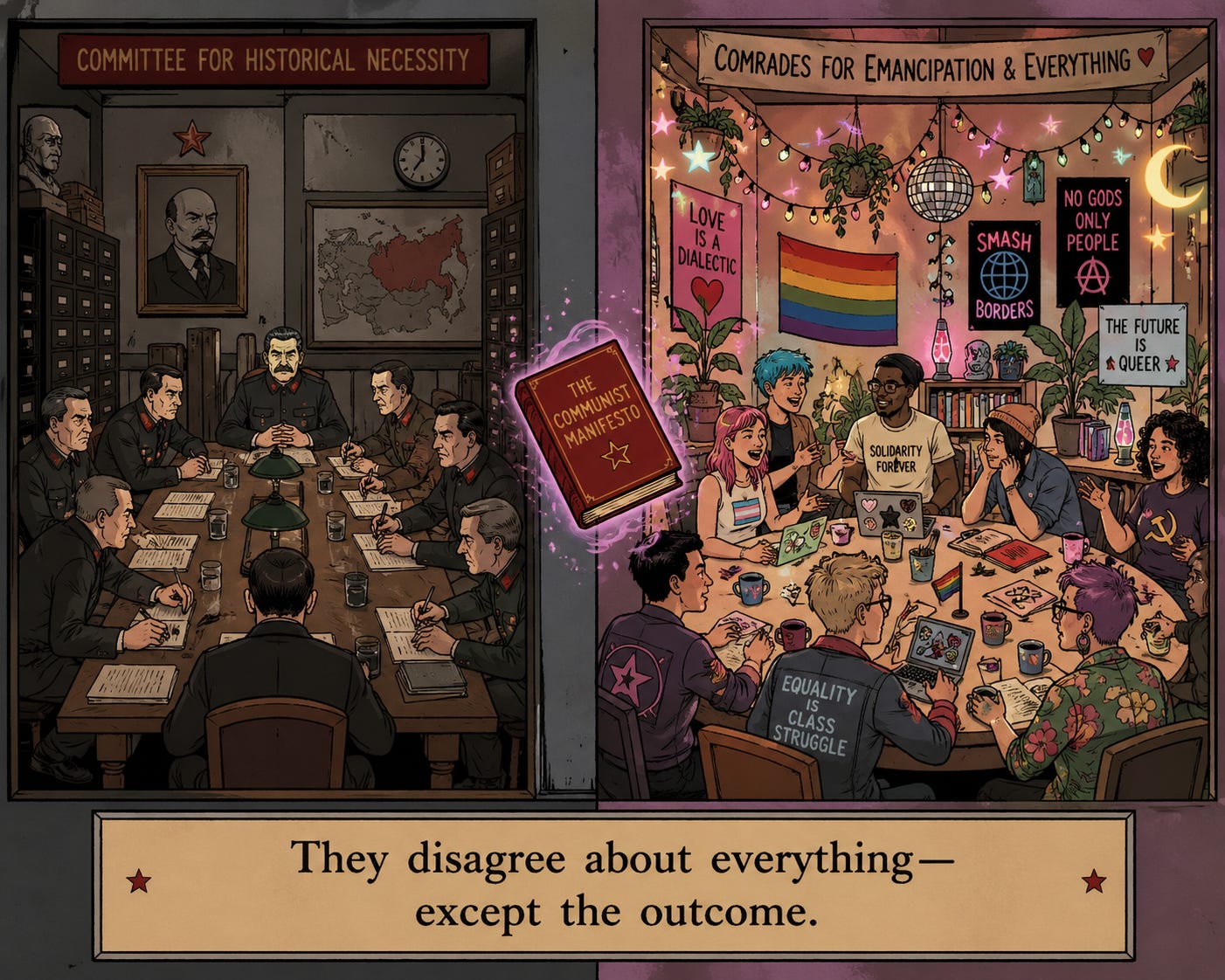
What I have consistently observed, in dealing with self-identified Communists, is a sharp divide not simply between believers and critics, but within Communism itself. There exists a cohort, often older, often shaped by longer intellectual exposure, who reject the crude polemics that dominated the Stalinist period.
These “revisionist but still Communist” figures do not accept the caricature of Leon Trotsky as a saboteur, nor do they treat Nikolai Bukharin, Karl Radek, and others as enemies of socialism. Instead, they regard the purges and denunciations under Joseph Stalin as distortions, incidental to the project rather than essential to it, and maintain that those eliminated were, in fact, genuine Communists.
In contrast, the more rigid and doctrinaire elements, often younger militants, tend to reproduce the old accusations with surprising zeal. For them, deviation must always be explained as betrayal, and figures like Trotsky become necessary villains in a simplified moral narrative.
What is striking is that those with the longest memory of the movement, including many older intellectuals (and, as I would note, indeed decisive, Jewish Communists shaped by both European history and personal proximity to these events), tend to be far more cautious. They recognize that the internal conflicts of early Soviet history were not a struggle between purity and treason, but between competing visions within a shared ideological framework.
This is lost on the younger militants who dominant the Left, whether they support the Soviet experience, or if they are Anarchists, social-democrats and others. This important distinction is lost on them, which actually solidifies my view, that the Left logically gravitates to religious thinking rather than to anything “scientific.”
This more restrained interpretation is not unique to just my own experience observing the Far-Left. It aligns with strands of thought found among post-war Western Marxist historians and dissident Communists who attempted to salvage the intellectual core of Marxism while acknowledging the political distortions of the Soviet state.
The Myth of the “Wrecker”
Figures influenced by the later writings of people like Isaac Deutscher or E. H. Carr often arrived at similar conclusions: that the early Bolshevik leadership, despite its factionalism, represented a spectrum of legitimate socialist positions, and that the Stalinist consolidation required retroactively criminalizing that diversity.
Likewise, reform-minded insiders within the Soviet system itself implicitly conceded this point through their attempts at correction. The reform efforts associated with the Russian, Alexei Kosygin, particularly the 1965 economic reforms, were influenced in part by the ideas of Evsei Liberman, a Jewish economist who argued for limited market mechanisms within socialism.
The very need for such reforms suggested that the earlier system had calcified, and that its rigidities were not incidental but structural. Those who supported these reforms were, in effect, acknowledging that the system had suppressed viable alternatives, including some of the very figures once denounced as “wreckers.”
I would go so far as to say that this problem illustrates the force of certain capitalist arguments about incentives, not as ideology, but as constraint. Systems that fail to account for incentives do not merely perform poorly; they produce predictable distortions. This is often ignored by the Far-Left, which continues to point to surviving systems, particularly China, as evidence of viability. But that example only holds if one overlooks the extent to which such systems have already departed from strict planning in order to function at all. The point is not inevitability, but adaptation under pressure.
One crucial point that needs tightening from their side is the nature of Stalin’s role in the system. Figures like Danny Goldstick, Alec Nove, Moshe Lewin, and Isaac Deutscher do not usually treat Stalin’s actions as merely incidental errors layered onto an otherwise intact system. They recognize that the defeated figures, Trotsky, Bukharin, and others, were not “wreckers,” but participants in a real internal struggle. Trotsky did not lose because he was wrong in principle, but because he lacked the institutional position to win.
From there, the revisionist position becomes clearer, and more difficult to sustain. They argue either that Stalinism was structurally produced by the conditions of early Soviet development, bureaucratic consolidation, civil war pressures, economic backwardness, or that it marked a decisive turning point that fundamentally reshaped the system’s trajectory. But in either case, the implication is the same: Stalin is no longer an accident, but a product of the system under real conditions.
Goldstick’s tendency to treat purged figures as genuine Communists aligns with this refusal of the “wrecker” narrative; Nove emphasizes that viable economic alternatives (often associated with figures like Bukharin) were suppressed rather than exposed as sabotage; Lewin frames Stalinism as a bureaucratic deformation emerging from real structural pressures; and Deutscher explicitly portrays the defeated opposition as authentic revolutionaries overtaken by a changing political environment. In other words, I think the Communist Left has a built in tension in both their thinking and coalition building that cannot be easily resolved logically.
From Science to Dogma
What is consistently missing from the revisionist position is not moral seriousness, but institutional clarity. It is not enough to say that better men, or better interpretations of Marx, might have prevailed. The question is structural: what mechanism, what constraint, what incentive would have selected for those better outcomes? A system that concentrates appointment power, controls access to information, and eliminates independent bases of authority does not merely risk abuse, it guarantees that political survival becomes the highest rational objective.
Under such conditions, the victory of a figure like Joseph Stalin is not an anomaly, but a selection outcome. The revisionists are therefore left in an untenable position: they must either admit that the system generated the very behavior they condemn, or retreat into a hypothetical version of Communism that has never existed and, under real pressures, likely never could. This is not a moral failure, it is a design failure. Once the Party controls appointments, information, and enforcement simultaneously, there is no independent mechanism left to check consolidation.
The distinction this creates is decisive: it separates the naïve claim that “Stalin simply corrupted a good system” from the harder, more defensible argument that “the system, under pressure, produced Stalin.” In other words they are arguing that these are birth pangs for their ideal system. Which brings me again to my resulting skepticism from experiencing the Far-Left, up close; they could not answer the problem of calculation or of incentives, which Von Mises and others such as Leszek Kołakowski have found crucial.
From my own standpoint, while I am not a Communist, it seems that this revisionist position is the only intellectually defensible one available from within that tradition. The hardliners, for all their role in building and consolidating the state, inherit a far heavier burden. Needless to say while liberal-democracy in my view is not responsive to the actual desires of the honest working-native born-citizen populations, I see the Communists as having an upward battle of justifying how they would be more responsive.
They make the seeming incoherent White Russian Third-Worldist brutality of a Aleksandr Dugin seem much more in line with their own history. You cannot exactly complain about liberal-democracy, while it supplies people with all those leftist social causes and distractions that were not supplied under the Russian Tzar. In that system, you could well complain about oppression, especially from the perspective of the “ignorant” and non-Marxist, peasant “right wing” which was entirely “democratically” obstructed from the system at the very time of the Far-Left first and only decisive victory on the fringes of Europe. This asymmetry makes Left-wing complaints about liberal-democracy structurally weaker, while strengthening those who claim exclusion from it.
What this ultimately exposes is that the revisionists are trying to occupy a position that history itself does not easily permit. If the Bolshevik victory required the exclusion and indeed the silencing, of the very populations it claimed to liberate, then the problem is not merely one of excess, but of foundation. The Left was operating from a very different foundation in the past, a different set of contingencies, a different framework than they can ever possibly hope to convince us of in the present. They had a different situation, which favored their narrative. In the present they can only latch onto crisis and “oppression” narratives, that exist from any political perspective, not merely their own.
The peasant majority, dismissed as backward or “non-conscious,” was not incorporated but overridden; their preferences did not fail to register, they were structurally irrelevant. In that light, the comparison to Aleksandr Dugin is not as incoherent as it first appears: both frameworks, in different language, subordinate the actual population to an ideological project that claims higher necessity.
The liberal-democratic order, for all its distractions and inconsistencies, at least permits fragmentation, dissent, and partial expression; it diffuses power rather than resolving it. The Bolshevik model, by contrast, resolved the question decisively, and in doing so revealed that its “democratic” claims did not extend to those who stood outside its ideological premises. The real question, then, is unavoidable: if the system required the exclusion of the majority at its moment of triumph, on what grounds can it claim to be more representative, more responsive, or more legitimate than the flawed order it seeks to replace?
Why the Tsar Was Easier to Defeat
From my perspective, this also clarifies something the revisionists tend to understate: the Tsarist system was, in many ways, an easier enemy to overthrow than liberal-democracy ever could be. The autocracy of Nicholas II presented a centralized, visible, and brittle target, power was concentrated, legitimacy was narrow, and opposition could unify around a single axis of collapse.
By contrast, liberal-democracy disperses power, absorbs dissent, and fragments opposition into competing causes, many of which are actively encouraged and institutionalized. It does not deny expression; it multiplies it. This makes it far more resilient; it makes complaints about it from the Far-Left look weak and silly, while ceding the real moral incitement to the Right. Thus, only the Right and Far-Right can really even claim a “right” to complain about the system, which in a similar way seeks to cut them out of all conversations. This has been noted for a long time, with the Leftist domination of Media and Academic institutions, while wielding zero power over the hearts and minds of workers who toil without government assistance of patronage.
In contemporary liberal democracies, sectors like engineering, trades, and many private-sector roles reward output, constraints, and feedback from reality, deadlines, budgets, physical limits, customers. That environment tends to cultivate skepticism toward grand, centralized schemes and a preference for predictability, property rights, and decentralized decision-making.
By contrast, parts of media and academia are more insulated from those direct feedback loops and are structurally oriented toward narratives and norm-setting, often with funding streams tied to public or non-governmental institutions. That doesn’t make “The Right” virtuous and “The Left” necessarily corrupt; it means they develop different default intuitions about power and coordination; and one is much more prone to bias.
From Free Thinkers to Gatekeepers: The Answer: Nothing Would Have Stopped Him
For Communists and left theorists, this creates a problem: the constituencies most comfortable with centralized planning are often not the ones operating under the tightest real-world constraints, while those who are tend to be wary of it. The historical inversion is instructive.
In early Soviet Russia, many of the regime’s sharpest critics and independent thinkers came from universities and intellectual circles, and were expelled in events like the Philosophers’ Ship, while the new regime consolidated authority over institutions that shape discourse. The pattern isn’t identical today, but it highlights a recurring inverse tension: who bears the costs of centralized decisions, and who has the power to legitimize them?
The Bolsheviks did not defeat a system that could flex, they defeated one that could not. And this matters: a revolutionary strategy that succeeds against a rigid autocracy does not automatically translate into one that can overcome a system designed to diffuse, redirect, and partially satisfy the very grievances it produces. In that sense, the decisive victory on the fringes of Europe says less about the universal strength of the Communist project than it does about the particular weakness of the regime it replaced, and raises the uncomfortable question of whether that same project could ever achieve comparable success against a more adaptive, pluralistic order.
They must defend a historical record that contradicts their own premises: a system that claimed to transcend human nature yet reproduced its most familiar patterns, power struggles, purges, and paranoia. The behavior of Stalin himself, the catastrophic misreading of adversaries like Adolf Hitler, and the repeated failure to implement corrective reforms such as those proposed by Kosygin and Liberman all point to a deeper flaw.
The deeper problem is not that Communists failed to understand power, but that they believed they could suspend it. In practice, power did not disappear. it concentrated. And once concentrated, it behaved exactly as it always has. Even Molotov, whose own wife was arrested, did not intervene, later expressing regret rather than resistance. The reality was simple: even at the highest levels, there was no mechanism, and no capacity, to stop Stalin. As the testimony goes, “Why didn’t you stop him?” / “Because no one could.”
It is not merely that individuals erred, but that the system proved too rigid to accommodate reality. In that rigidity, and in its inability to reconcile theory with human behavior, the limits of the ideology are most clearly revealed. *What, concretely, within the Communist system as it actually existed, would have prevented Stalin? *Answer: Absolutely nothing. Such a system of appointments, access and councils and electing councils necessarily implies dictatorship. Perhaps even a stronger dictatorship than anything Hitler and his allies had in mind. If Stalin was not incidental, then what, in the actual structure of Communism, would have stopped him? Nothing.