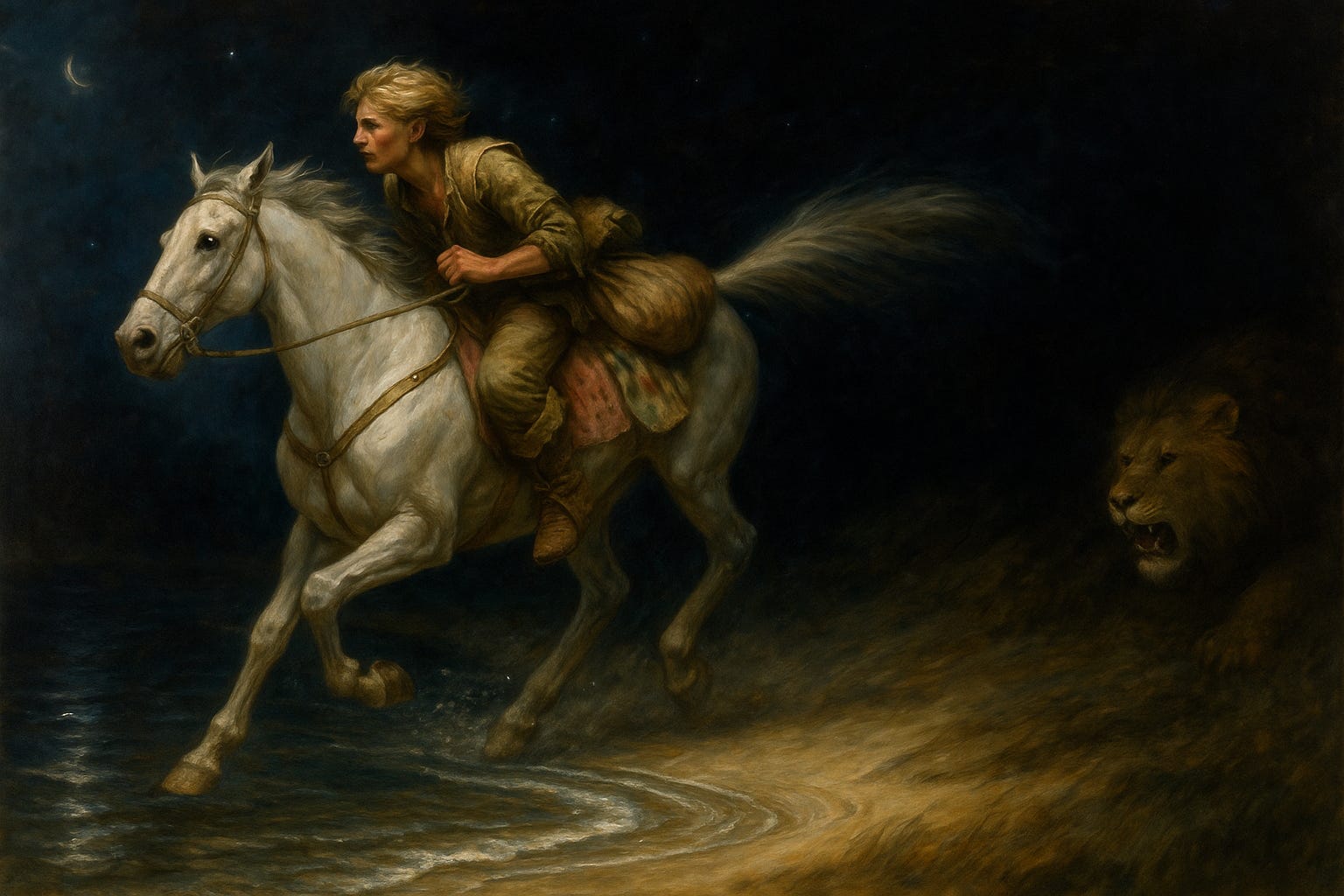
It’s genuinely ironic that Tolkien is so often accused of racism when, if one looks closely, C. S. Lewis could be far more open to that charge; and I think happily, for I think my childlike mind was for good or evil, far more subtly influenced by the preferences and insights of Lewis than of Tolkien. This, despite the fact, that the Roman Catholics of my youth, imposed Tolkien upon me at a much earlier age; practically stuffing him into my little hands in Grade 2: with much characteristic Catholic superciliousness.
Meanwhile, Lewis’s Chronicles of Narnia contain entire races and nations, such as the southern Calormenes, his thinly veiled stand-ins for Ottoman Turks, depicted as overtly foreign, decadent, and sinister; or the Telmarines, depicted as a slightly more assimilable eastern people. His narratives draw sharp visual contrasts between “golden-haired Narnians” and “dark-haired Telmarines,” a pattern that recurs throughout whole chapters. To a modern post-1965 conditioned reader, much of this would read as explicit xenophobia, yet few seem to notice. That blindness is almost darkly funny, since Lewis’s moral world relies heavily on visible, racialized markers of good and evil, even while claiming a Christian universalism. Tolkien does not explicitly ever do this; at least not without some moralistic caveat, or some exception.
Tolkien works in a completely different moral register from Lewis. His distinctions among peoples are metaphysical, not ethnic. His moral geography divides races into good and corrupted forms, Elves, Men, Dwarves, Orcs, but these divisions express spiritual fallenness, not skin color or national character. Within that framework, only one Elf, Eöl the Dark Elf, can be called wholly or nearly evil, in the human sense. The Elves themselves occupy a symbolic midpoint between angels and humanity: they are quasi-Catholic, quasi-Jewish beings, steeped in a sacred language (Quenya) that blends the tonal gravity of Latin, the structure of Finnish, and the theoretically Catholic sanctity of Hebrew. They are Tolkien’s image of unfallen intellect and beauty, a metaphysical ideal rather than an ethnic one. In terms of race, Tolkien, only very lightly touches on these things; the Elves are not tiny or sexually inviting sprites. They are tall, Giants even, meant more to be like Norse gods, in height and appearance, though walking the Earth with a more ethereal and non-violent bent.
In short, Lewis moralizes ethnicity, whereas Tolkien spiritualized being. Yet in the public imagination, it’s Tolkien who bears the heavier accusations, which I think makes the whole debate more than a little ironic. If anything, Tolkien is “less racist” than many liberal writers I can think of, who are far more stark in their realistic assessment of their own experiences put to the written page.
Where Tolkien “offends them”
There are at least two main passages from Tolkien, where is likely to trigger our current progressive “moralistic” norms, the most; the description of the Orcs in The Two Towers, and his delightful depiction of Denethor in The Return of the King. Of course, Tolkien also peppers his universe with a real world understanding, though it is filtered through his own Catholic restraints.
Physiognomy and “Class Awareness”
“The Men of the South looked different, broader and darker, yet not evil in their aspect.”
— The Two Towers, “The Window on the West”
Tolkien begins with a physiognomic observation (physical difference), but immediately undercuts it by adding “yet not evil in their aspect.” His moral compass immediately overrides racial judgment.
The Lineagist View
“Few ever came hither save outlaws or men in despair, flying from the shadow of the Dark Lord. Yet there were some among them that were of great lineage and valour.”
— The Return of the King, “The Black Gate Opens”
This shows how Tolkien distinguishes between lineage (a form of inherited spiritual nobility) and race. He often uses lineage as a moral measure, but lineage in Tolkien is metaphysical, not ethnic. It’s about fidelity to the divine design, not blood purity. Tolkien would no doubt consider his own “Black Numenorean” as akin to “Nazis” or to any kind of fallen Superhuman, or better than ordinary man, though not better necessarily according to his own Catholic lights.
Religious Reversal and Moral Equality
“The Shadow that bred them can only mock, it cannot make: not real new things of its own.”
— The Return of the King, “The Steward and the King”
This theological principle (evil as a corruption, never a creation) entirely cancels out any concept of racial essentialism. Orcs are not a “race” but a moral deformation of being, a perversion of the divine image, a metaphysical category, not an ethnic one.
The Running Orcs
If you read Tolkien’s letters, it’s clear he never meant his Orcs as racial allegory. Yet, some of their traits, especially in The Two Towers, where they are described as tireless runners who chant in rhythm and keep formation through day and night, unmistakably echo the image of Zulu warriors Tolkien might have heard about as a boy in South Africa. In other letters, Tolkien, suggested that they may have resembled the Mongols. So my answer to the Left is: Yes and No. Orcs are, by design, Goblins, mythical distortions of industrial evil, to some extent he saw in them the cruel sociopathic “industrial man” or the “careerist,” but the way their foot soldiers move, fight, and endure carries the imprint of Zulu martial imagery, not by ideology, but by the unconscious sediment of his memory.
Relentless Running and Endurance
“They had run all the way from the River, through the night, and yet they did not seem greatly wearied.”
“They kept up a swift tireless pace, loping along in a steady ground-eating rhythm that never slackened.”“They kept up a harsh croaking chant, and some of them beat time on their shields.”
“There was a note of savage exultation in their cries.”Physical Descriptions and Organization
“Broad, flat-nosed faces, slant eyes, and wide mouths with fangs. Their legs were short but very strong.”
“They moved in ordered companies, with a discipline that surprised the hobbits.”Comparison of Tribal Ferocity
“They seemed born to war, rejoicing in cruelty and endurance.”
“The great Orcs of Isengard were almost like men in stature and might.”
Tolkien’s religion, rooted in Catholicism, firmly cancels out any notion of subconscious “race awareness.” What he occasionally expresses instead is a sharp sensitivity to differences of lineage, the visible marks of moral and historical inheritance, not of biology. In his letters and fiction alike, Tolkien seems to believe that one can read moral or social history in a face, much as one reads weather in the sky. But whenever he approaches what modern readers might call racial description, he immediately corrects himself with a countervailing moral or theological statement, almost verse following verse. The pattern is unmistakable: every hint of hierarchy collapses into humility. What remains is not “racism,” but a spiritual taxonomy of fallenness and grace. Tolkien was, above all, a Lineagist: he believed that evil and nobility travel through story and covenant, not through skin.
Bloodlines and Burdens
In The Two Towers, Book III, Chapter 5, after Gandalf emphasizes that Denethor is a man of great strength of will and noble lineage, noting that his blood “runs nearly true”, linking him to the ancient Númenórean line of Gondor. This underscores both his potential for greatness and the fading of noble lines over generations. Essentially, Denethor, is Tolkien’s “Super Aryan” or “Super Hitler.” He acknowledges his blood superiority while condemning him morally, as failing his own Catholic moral tests of “Faith, Hope and Charity.” This is not something a “racist” would ever do.
Meanwhile, Pippin observes Denethor and remarks that he bears a striking resemblance to Aragorn, highlighting, visually, the connection between the Stewards and the true King. Tolkien thus layers lineage, personal strength, and physical resemblance to signal Denethor’s quasi-regal nature, even as Gandalf hints at the limitations imposed by his declining bloodline and pride.
While Tolkien praises the genealogy and physiognomy of Denethor he also checks himself by condemning him, for being despairing which is always the common Catholic attack or moralistic checkpoint, thus Tolkien is deftly avoiding the charge of “racism” in this way: Gandalf, upon confronting Denethor, declares, “Despair, or folly?” and later states, “It is not despair, for despair is only for those who see the end beyond all doubt.” These moments underscore Denethor’s failure to embody the Catholic virtue of hope, a central tenet in Tolkien’s moral universe. Through this, Tolkien deftly navigates the accusation of “racism,” illustrating that while Denethor’s lineage is noble, his moral downfall stems from spiritual failure rather than ethnic or racial decline. This distinction highlights Tolkien’s emphasis on inner virtue over hereditary status.
Compare Tolkien to Frank Herbert
Tolkien famously hated Frank Herbert, and I know why without him even saying a word. While Tolkien lives inside a Catholic universe; Frank Herbert dissects it with dark absurdism, and clearly lives outside it as a clinician examining human rationalizations. Nevertheless, Frank Herbert would also offend the Left if only they could pay attention.
Where Tolkien avoids all sex and sexuality, almost entirely, with only two or three famous instances of implied nudity or rape (e.g. Nienor’s escape/rape in The Silmarillion, Frodo in the Tower) Frank Herbert does almost the opposite.
He portrays his villains more overtly with deviant or non‐normative sexuality, especially the Baron Harkonnen, who is repeatedly described with traits like effeminacy, obesity, cruelty, sexual predation toward young slave‐boys, incestuous desire, etc. Herbert uses the Baron as more or less the only explicitly gay character in Dune, and wraps him in every possible trope of moral corruption. I can spot him doing this repeatedly, actually. The pattern in Dune strongly supports the impression that Herbert equates non‐normative sexuality (especially male‐male desire, incest, and sexual deviance) with selfishness, cruelty, and soulless predation. Which it is. Thus, in Herbert’s fiction, the moral opprobrium attaches far more directly to sexuality than it does in Tolkien’s work, where sexuality is almost entirely muted. You would think, they would have canceled Herbert first, but since they are foolish distracted by the atheism and social democracy of Herbert, they miss it.
C.S. Lewis Lived Far More in the “real world” than Tolkien
In The Horse and His Boy, C. S. Lewis deliberately draws attention to the racial consciousness and moral contrasts between Narnia and Calormen. In one of my favorite chilling passages, the Calormene Tarkaan immediately notices Shasta’s fair complexion, marking him as an outsider, and implicitly contrasts him with the darker-skinned inhabitants of his empire. ( Something at least a conscious, hurt, pained, number of us who have grown up in multiracial urban areas have been made to feel. )
“This boy is manifestly no son of yours, for your cheek is as dark as mine but the boy is fair and white like the accursed but beautiful barbarians who inhabit the remote North.”
Lewis emphasizes that, despite Shasta’s presence in Calormen, he is never fully accepted; his racial difference renders him perpetually foreign, a fact the narrative underscores repeatedly. Through this, Lewis educates his young readers about the harsh realities of non-white envy, pride, arrogance, and lechery as they manifest along perceived racial lines, showing that moral corruption and prejudice are intertwined with their cultural and physical difference. In this sense, Lewis is far more overtly a “race realist” than Tolkien: while Tolkien universalizes moral failure as a metaphysical or spiritual flaw, Lewis insists that societal perception and racial otherness have real consequences for identity and treatment, even for a child hero like Shasta. This is exactly the point that “race realists” want to make, however clumsily and hamfistedly, but Lewis got it across to my 9-year old self, much more effectively and subconsciously. He has many passages like this, far more striking. It is a wonder that he has not been canceled. Liberals and Leftists are just not close readers; you have to basically hit them on the nose for them to notice things.
Conclusion
The irony, at least to me, is unmistakable: Tolkien, whose moral universe is rooted in Catholic theology and metaphysical distinctions, bears the brunt of accusations of racism, while writers like C. S. Lewis, who repeatedly foreground ethnicity, physical difference, and cultural otherness in The Horse and His Boy, The Last Battle, Prince Caspian, and even more subtly in The Magician’s Nephew, are largely overlooked. Lewis, by comparison should be seen as far more overtly a “race realist” than Tolkien. They would hate this. I approve.
Indeed, many liberal writers of the 19th and 20th centuries, from Dumas to Kipling to Melville, presented their characters and nations in starkly physicalized terms, yet were rarely censured for it. Tolkien’s subtlety, his focus on spiritual and lineal virtue rather than skin or nation, is morally precise and theologically consistent. The irony, then, is double-edged: Tolkien’s work is both more humane and more metaphysically sophisticated, yet modern readers, distracted by surface-level anxieties about race, mistake his moral typologies, for an attempted attack on their pathetic racial platitudes.
Meanwhile, Lewis, Dumas, and other liberal observers of human differences confront the stark realities of race, lineage, and prejudice head-on, and largely escape the same moralistic censure, from liberals and “progressives.”