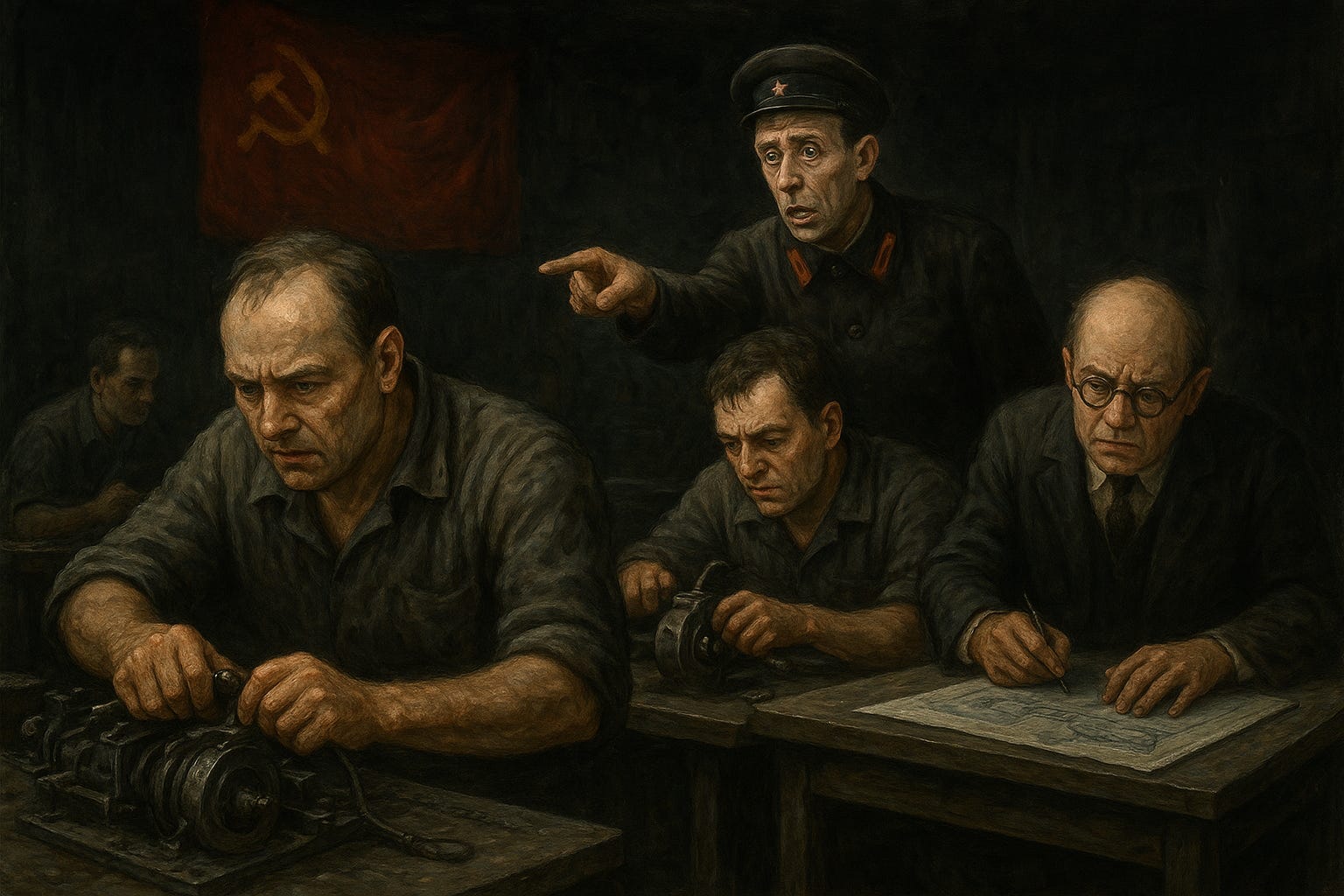
“I see, in place of that empty figment of one linear history … the drama of a number of mighty Cultures, each springing with primitive strength from the soil of a mother‑region … each limited in duration and self‑contained … each stamping its material, its mankind, in its own image; … then ripen, decay, and never return.”
- Oswald Spengler, “The Decline of the West” (Vol. I: Form and Actuality)
This is a statement of metaphysical fatalism that would make all the Leftists fume and sneer; because they think only they have the secret to universal fairness, equality and uplift. I know. Ridiculous.
“The old bourgeois and imperialist Europe, which was accustomed to look upon itself as the centre of the universe, rotted and burst like a putrid ulcer in the first imperialist holocaust. No matter how the Spenglers and all the enlightened philistines, who are capable of admiring (or even studying) Spengler, may lament it, this decline of the old Europe is but an episode in the history of the downfall of the world bourgeoisie …”
- V.I. Lenin, 2 May 1922 article “On the Tenth Anniversary of Pravda”
Spengler’s first claim, that Western civilization was in irreversible decline, struck at Lenin’s revolutionary optimism, which held that class struggle and proletarian agency could reshape society. Spengler added that ordinary people are passive, swept along by the currents of history, and that culture exists independently of material and technological conditions, deteriorating even if industry or wealth increased. Marxists think that “the masses,” properly organized by the Party, could seize control of production, direct history, and subordinate culture to the revolutionary cause. In theory, the promise of collective action and industrialization would overcome fatalism and cultural decay, making Spengler’s pessimism irrelevant.
In practice, however, Lenin’s optimism confirmed much of what Spengler warned. Despite the seizure of power and rapid industrial initiatives like the GOELRO plan, famine, requisitioning, and civil war caused massive human suffering. The masses were mobilized politically but remained materially devastated, illustrating that agency alone cannot ensure abundance. Cultural initiatives were subordinated to ideology, and coercion destroyed the trust of the people, socially and culturally requiring more and more coercion by the Communists, which they still struggle to live down, on the Left even to this day.
Even Lenin’s revolutionary will could not break the underlying forces Spengler described: complex socio-economic realities, the fragility of life under abrupt structural transformation, and the limits of human control over historical processes. By the end, the early Soviet experience ironically validated Spengler’s thesis, showing that even the most determined revolution could not escape the harsh realities of decline, human mortality, and systemic complexity.
After Lenin’s death, Stalin inherited a society fractured by civil war, famine, and ideological coercion. To stabilize, he had to “bring back” Russian patriotism, promoting national symbols, historical heroes, and military traditions, permit a limited revival of religious practice, meaning some basic liberties, including the Orthodox Church. This was a pragmatic acknowledgment that cultural identity and spiritual attachment could not simply be eradicated through class-based revolution. Despite decades of Marxist ideology, Stalin realized that deep cultural currents and collective memory remained decisive forces shaping society, exactly as Spengler predicted: civilizations have enduring spiritual and cultural structures that resist purely rationalist or materialist transformation.
In other words, even the most determined revolutionary project could not escape Spengler’s warning that culture and identity operate on their own logic, beyond the control of political or economic engineering. Lenin imagined that revolutionary zeal and class-conscious organization could rewrite human behavior wholesale, but Stalin’s concessions reveal the limits of that optimism. Material and political power could reorganize production, but the soul of the civilization, its rituals, religion, patriotism, and cultural identity, could not be fully reprogrammed, reinforcing Spengler’s point about the autonomy and resilience of cultural forces.
Furthermore, there is nothing inherently “socialist” about optimism or concern for human welfare. Long before Lenin seized power, Western Europe had begun to address the material and social conditions of its working class: labor laws, public health initiatives, limited work hours, education reforms, and safety regulations emerged incrementally from the Industrial Revolution onward. These measures improved living standards and reduced the sense of desperation that revolutionary Marxists claimed justified their seizure of power. By the time the Soviets attempted to mobilize workers under the promise of class emancipation, many Western workers already enjoyed tangible gains without violent upheaval. This made the Marxist hold on the “workers” was structurally weak, they were being asked to give up improvements already achieved organically in the West in exchange for abstract ideological promises. This is why Leftists fail to attract large numbers to their ranks, despite being completely tolerated and embedded in the system to a degree that Nazis never would be.
ELON MUSK: Optimism & Demonstrated Achievements
Elon Musk represents the kind of materialist optimism Lenin claimed to champion, but demonstrated it through engineering, not ideology. Musk’s core belief is simple: progress is the result of building things that reduce scarcity. And unlike theoreticians, he can point to tangible transformations, the first mainstream mass-market electric cars, the first fully reusable orbital-class rockets, and the first global low-orbit satellite internet system. Each of these is a physical proof that optimism backed by engineering produces abundance. Musk can say: “If you want human flourishing, you increase energy capture, reduce transport costs, expand communication, and make technologies cheaper for billions, no dialectic required.”
Musk’s optimism has produced quantifiable, global results. SpaceX cut launch costs from ~$60,000/kg to ~$1,500/kg, opening access to space to nations, universities, and industries that were previously locked out. Tesla dropped the cost of EV batteries more than 80% in a decade, accelerating the largest industrial energy shift in modern history. Starlink connected millions of rural, poor, and isolated people who had no internet access at all. These changes, inexpensive energy storage, inexpensive orbital access, inexpensive connectivity, represent the exact kind of abundance Lenin believed would free humanity, but Musk achieved it empirically, voluntarily, and through innovation rather than coercion.
JENSEN HUANG: Optimism & Demonstrated Achievements
Jensen Huang embodies another branch of materialist optimism: computation as the engine of human progress. He didn’t theorize about revolution or build utopian societies, he built GPUs powerful enough to trigger the AI revolution. By turning NVIDIA from a gaming graphics company into the backbone of global AI infrastructure, Huang made it possible to scale scientific research, drug discovery, robotics, climate modeling, and machine learning at speeds that were previously unimaginable. He can say: “To uplift humanity, you democratize compute. Make intelligence cheap, and the world becomes richer, safer, and more productive.”
Under Huang’s leadership, GPU power increased by factors of thousands while costs per unit of computation fell dramatically. Breakthroughs in protein folding, fusion research, cancer detection, weather prediction, and agriculture optimization all run on NVIDIA hardware. AI models that can tutor children, write software, translate languages, and accelerate science exist because Huang made giant compute clusters accessible to universities, labs, and startups. In terms of material abundance, Huang’s achievements dwarf anything created by political ideology in the 20th century. he made intelligence scalable, and therefore made “progress” scalable.
Lenin and his failed achievements; And his requiring intense rationalization, achievements
Lenin was also an optimist, but built on a theory of class struggle rather than engineering. He believed human liberation would come from a centrally directed socialist state, not from market-driven innovation. His two major achievements were political: the consolidation of Bolshevik power and the launching of the GOELRO electrification plan. Electrification was visionary, Lenin famously said, “Communism is Soviet power plus the electrification of the whole country.” But in practice, the early Soviet economy suffered catastrophic shortfalls: industry collapsed after the revolution, famine hit millions, and the material standard of living declined for years before recovering. Lenin created the blueprint for a strong state, not for abundance.
Lenin’s other “achievement” was the political precondition for collectivization: the establishment of a one-party apparatus with total control over economics and agriculture. Though Lenin died before Stalin’s collectivization, Lenin created the Cheka, the requisitioning system, the War Communism mentality, and the notion that the peasantry must be broken for socialism to advance. These mechanisms collided with agriculture in the 1930s and produced the Ukrainian famine, the Kazakh famine, and millions of deaths across the USSR. Lenin wanted uplift, he delivered the political instruments of coercion that led to mass starvation. He ultimately granted instruments later used to purge most his own old gang.
COLLECTIVIZATION failed in Agriculture; worked in industry
Collectivization fails in agriculture because farming is hyper-local, knowledge-intensive, seasonal, and dependent on individual incentives. A single farmer’s decision about when to seed, how to rotate fields, and how to treat diseased crops can’t be effectively managed from a central committee hundreds of miles away. Removing ownership eliminates the farmer’s incentive to maximize yield, and confiscatory quotas destroy any incentive to innovate. In industry, large-scale coordination can succeed, factories benefit from standardization, automation, and predictable inputs, but agriculture relies on decentralized tacit knowledge that cannot be bureaucratized. Socialism tries to turn farmers into factory workers, and in doing so destroys food production.
Industrial collectivization works because machines, assembly lines, and centralized logistics thrive under uniform control: steel, chemicals, military hardware, and railroads can benefit from command coordination, especially in wartime. But agriculture is the opposite: unpredictable, biological, local, weather-dependent, and sensitive to marginal differences in care. When socialist systems forced peasants into collective farms, the mismatch between ideology and biology triggered collapse. The result was famine, coercion, mass deportations, and the destruction of rural life. Socialism in industry is costly but functional; socialism in agriculture is deadly.
Ultimate Takeaway: Why Leninism’s Complaint Is Largely Meaningless Today
Lenin feared that elites and pessimistic intellectuals would demoralize the “workers” and make revolution impossible. But in the 21st century, workers no longer need leverage through political coercion, they gain agency via technology, knowledge, and innovation. Spengler’s pessimism is empirically falsified in multiple domains of human material and intellectual achievement; while confirmed in several others. Most people cannot trust their neighbors and despite “socialism” being de facto in academia, the majority of workers distrust and avoid its advocates.
Leninism’s warning about fatalism and elite control over progress is now largely obsolete: the abundance-generating power of modern engineering, AI, and global connectivity bypasses the need for class struggle to deliver human flourishing. In short: Lenin’s critique of Spengler is now moot, not because pessimism was wrong in principle, but because human agency has shifted from political coercion to issues of technological coercion or technological empowerment. Demonstrating that there is a difference, and that the difference is not “proved” simply by having supremacy.
A central problem with Leninist and broader Marxist revolutionary optimism is its assumption that human behavior can be remade purely through ideology and class-conscious organization. By treating culture, morality, and traditions as secondary to material restructuring, Marxists remove the natural stabilizing forces that guide social cooperation. Ordinary people do not live by abstract notions of historical inevitability; they live according to local norms, religious habits, ethical intuitions, and inherited traditions. Ignoring these forces creates a gap between state objectives and lived human reality, a gap that coercion must fill.
In contrast, materialist optimists like Musk or Huang demonstrate that human flourishing can be achieved without coercion, because they work with human capacities, needs, and aspirations rather than against them. By building technologies that people actually want to use, electric cars, reusable rockets, scalable AI, they align innovation with natural incentives and desires. Marxist theorists presume that ideology alone can override centuries of cultural practice. As Spengler warned, civilizations contain enduring spiritual and cultural structures; when these are ignored, coercion becomes unavoidable, not because people are “backward,” but because they are humans embedded in living traditions that cannot simply be erased.
Even Spengler would have pointed out that modern capitalist materialist projects, no matter how “advanced,” carry their own forms of coercion. Consider Peter Thiel’s Palantir: the software organizes populations, predicts behavior, and exerts control in ways that, if deployed by the state or for profit, provoke immediate moral outrage among Leftists.
Marxists, by contrast, are comfortable with coercion as long as they wield it. In effect, their ideology, stripped of respect for morality, tradition, or what the people actually want, proves that they were never truly doing science in the first place; they were replacing enduring cultural and social patterns with their own feelings and abstractions. Denying metaphysics while claiming scientific objectivity is meaningless when their “science” consistently failed, producing famines, purges, and deaths of loyal engineers and innovators.
Figures like Sergey Korolev, Valentin Glushko, and Andrei Tupolev, brilliant Soviet engineers who were not “enemies of the people” but suffered imprisonment, purging, or death under Stalin’s regime, demonstrate this. The Leftist claim to rational science was subordinate to ideology, coercion, and the replacement of human tradition with party orthodoxy. Spengler would see this as the inevitable consequence of ignoring the cultural and moral foundations that structure human societies, once again proving that even the most technologically and politically ambitious projects cannot escape the realities of human civilization.